
Invisible Tax: Why Diesel Prices Hit $5 Are a Threat to Your Wallet (And What to Do About It)
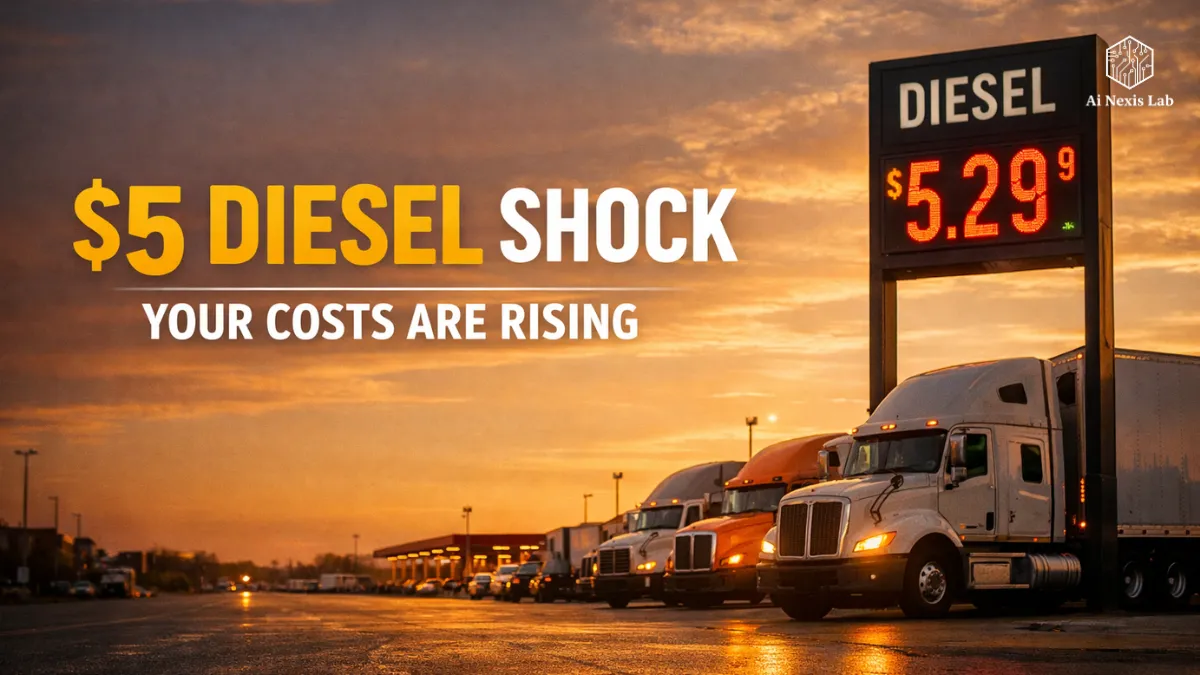
Diesel prices hit $5 in 2026, driving inflation fast. Discover 7 shocking impacts on food, shipping, and your wallet – and how to stay ahead now.
Take a second and look at the closest thing around you.
Your phone. Your desk. Your shoes.
None of that came out of thin air. Everything you touch has traveled – often thousands of miles – on trucks, ships or diesel-powered machinery.
Now here’s the uncomfortable reality: Diesel crossing $5 a gallon in the United States isn’t just a headline – it’s a system-wide cost shock. And unlike gas prices, which hit you straight at the pump, diesel hits you everywhere, quietly and relentlessly.
Groceries. Delivery. Construction. Utilities. Services.
This is not an increase you ignore. It’s a structural pressure that seeps into almost every dollar you spend.
What you are seeing is not inflation in summary. It is a real-time cost transfer mechanism from global volatility directly into your daily life.
Let’s break it down properly – without the fluff.
Table of Contents
“The Hormuz Chokehold”: Why Global Conflict Falls on Your Local Pump
If you don’t understand this part, you don’t understand anything else.
The Strait of Hormuz is one of the most important oil transport routes on the planet. Approximately 20% of global oil supply passes through the narrow corridor between Iran and Oman.
It is not a “regional issue”. It is a global choke point.
What Has Changed In 2026?
- Tensions in Iran escalate
- Tanker risk premiums rise
- Insurance costs increase drastically (3-5x in some cases)
- Shipping delays and rerouting
When risk increases, the price doesn’t rise gradually – it immediately comes back into price.
Oil traders are not waiting for disruption. They price in the possibility of disruptions.
That’s why crude is rising so quickly.
But Why Diesel In Particular?
Most people here get it wrong.
Diesel is not just another fuel – it is the basis of:
- Freight trucking
- Agriculture
- Construction
- Industrial equipment
- Rail transportation
Gasoline demand is elastic. Diesel demand is not.
You can reduce leisure driving. You can’t stop moving food.
And diesel is hard to replace. EVs are on the rise, yes – but they are not even close to replacing long-haul freight vehicles or heavy machinery on a large scale.
So when supplies tighten globally, diesel becomes the fuel of choice.
And right now, demand is winning.
From Diesel to Dinner Pipeline: Why Your Grocery Bill Is Rising
Forget about “inflation” as a popular term. Let’s find out the reality.
Take a simple thing – a piece of lettuce.
Step-By-Step Value Chain:
1. Agriculture
- Tractor → Diesel
- Irrigation pumps → Often diesel-powered
- Harvesting equipment → Diesel
2. Processing And Packaging
- Sorting, cooling, packing → Energy-intensive
3. Transport
- Refrigerated trucks (reefers) → Diesel engine + cooling diesel unit
- Long-haul logistics → Thousands of miles
4. Distribution
- Warehouse, last-mile delivery
At each stage, diesel is burned.
What Happens When Diesel Goes Up $1-$1.50 Per Gallon?
That cost doesn’t disappear. It gets passed on.
Trucking companies add fuel surcharges
Wholesalers raise prices
Retailers adjust margins
And suddenly your $3.99 lettuce is $5.49.
Key Truth:
This is not an alternative price. It is the cost of survival.
No one in the chain can absorb the continuous fuel increase without going down.
The Farmer’s Dilemma: Planting Seeds in a High-Cost Environment
Here’s where things get more dangerous – because it’s not just about current prices. It’s about future supplies.
Farming operates on tight margins and high initial costs.
Core Inputs:
- Fuel
- Fertilizer (linked to natural gas prices)
- Equipment maintenance
- Labor
When diesel remains high:
- Costs per acre increase sharply
- Break-even threshold increases
- Risk tolerance decreases
What Farmers Actually Do:
They don’t just “eat costs”. They adjust behavior.
- Plant fewer acres
- Switch to lower cost crops
- Delay investment
- Next price increase
This is how you get late inflation.
The impact is visible months – or even a year – later.
Feedback loop:
More fuel → Higher planting costs → Reduced supply → Higher food prices → Continued inflation
This is not temporary. It compounds.

Trucking “Blood Bath”: Small Fleets vs. $5 Wall
This is the part that most analysts give less importance to.
The trucking industry is not dominated by large corporations – it is fragmented.
Thousands of small operators operate 1-10 trucks.
The Math They Are Facing Is:
- Fuel tank: ~300 gallons
- Cost per fill: ~$1,500+
- Weekly fuel costs: $4,000–$6,000
Now combine that with volatile freight rates.
The Real Problem:
Spot rates (how much drivers get paid per load) don’t adjust immediately.
So when diesel goes up:
- Costs go up immediately
- Revenues go down
- Margins collapse
What Happens Next:
- Owner-operators exit the market
- Small fleets go bankrupt
- Capacity goes down
And then?
Big carriers take over with more pricing power.
This increases long-term shipping costs, not decreases them.
So the system becomes less competitive and more expensive.
Political Firestorm: Energy Independence vs. Global Reality
This is where the stories break.
You will hear politicians say:
- “We just need to produce more oil”
- “We can find our way”
That is incomplete at best.
Reality Check:
The US is a major oil producer – but the price of oil is set globally.
If global prices rise, domestic producers sell at global rates.
You don’t get a discount just because it’s drilled locally.
The real bottleneck: Refining capacity
This is the part that almost no one talks about.
We haven’t significantly increased U.S. refining capacity in decades.
This means:
- Limited capacity to convert crude oil into diesel
- Refineries are already running close to maximum capacity
- There is ₹ quick way to increase production
So even if crude oil supply increases, diesel supply does not increase proportionally.
It’s a structural barrier – not a policy change.
The “Bullwhip Effect” on Consumer Goods
Now we enter behavioral economics.
The “bullwhip effect” describes how small cost changes lead to large price changes in an upward flow.
Here’s How It Happens:
- Fuel prices rise
- Businesses expect more increases
- They raise prices above current costs
- Consumers accept higher prices
- Prices become sticky
The Inconvenient Truth:
Once prices rise, they rarely come back down completely.
Not because costs stay high – but because:
Businesses test what you’re willing to pay.
If you keep buying at $7, why would they go back to $5?
In this way, temporary shocks become permanent price levels.
Strategic Pivot: How to Navigate the “High-Fuel” Era
You Can’t Control Global Energy Markets.
But you can control how exposed you are to them.
1. Bulk Buying and Front-Loading
If prices are rising, it is irrational to delay buying.
Buying non-perishable items early is effective:
- Guaranteed returns
- Risk-free savings against inflation
But don’t overdo it. Hoarding ties up cash and creates storage waste.
Be strategic, don’t panic.
2. Hyper-Local shift
Long supply chain = high diesel exposure.
Short supply chains = cost stability.
Farmers markets, local suppliers, regional services – they’re not just “nice” – they’re economically efficient in a high-fuel world.
3. Efficiency Audit
Most people underestimate how much waste there is in their daily logistics.
- Multiple small deliveries instead of one consolidated order
- Unnecessary driving trips
- Poor route planning for businesses
Reducing inefficiencies is the fastest way to reduce diesel exposure.
Insider Tip: The “Surcharge” Trap
This is important.
Fuel surcharges often exceed actual cost increases.
Businesses use them to:
- Margin protection
- Profit expansion
Don’t just blindly accept them.
Ask for:
- Breakage calculations
- Historical comparison
- Justification
If they can’t explain it clearly, you’re probably paying too much.
“Future-Proofing” Frameworks (Your Strategic Survival Methods)
You are not solving this problem. You adapt to it.
1. Locality Pivot (Proximity Power)
Distance equals cost.
The more miles your goods travel, the more vulnerable you are.
Reducing that gap is the simplest structural advantage you can make.
2. Energy Decoupling
If your entire life depends on diesel-based systems, you are exposed.
Reducing that dependency is critical.
Examples:
- Solar for residential sustainability
- Electrification where practical
- Alternative delivery methods
This is not about being “green”. It’s about reducing volatility.
3. Value-Intensive Consumption
Cheap products become expensive when logistics costs dominate.
Buying low-quality items repeatedly means:
- More shipping
- More replacements
- Higher long-term cost
Durability beats cheapness in high-fuel economy.
Frequently Asked Questions
Is $5 diesel here to stay?
Not permanently at that particular level – but the floor has moved upwards.
The price situation before 2020 no longer exists. Amid geopolitical instability, tight refining capacity, and energy transition pressures, $4+ diesel is perhaps the new baseline.
There will be a temporary reduction, but it is unrealistic to expect a return to $2-$3 diesel in the long term.
Why doesn’t the government release more oil?
Because oil is not the obstacle – refining is.
The Strategic Petroleum Reserve releases crude oil, not finished diesel.
If refineries are already operating near capacity, adding more crude doesn’t magically increase diesel production.
It helps marginally, but it doesn’t solve the main obstacle.
Will this cause a recession?
Historically, sharp increases in energy have been strongly associated with recessions.
Here’s why:
1) Fuel prices rise → Food and goods prices rise
2) Consumers cut discretionary spending
3) Businesses slow down
Consumer spending accounts for ~70% of the U.S. economy, so continued pressure could cause a contraction.
It’s not certain – but the risk is real.
Why can’t we convert trucks to electric?
Because physics doesn’t cooperate.
Long-haul trucking requires:
1) High energy density
2) Long range
3) Fast refueling
Current battery technology struggles with:
1) Weight (reduces cargo capacity)
2) Charging infrastructure
3) Downtime
Electric trucks will grow – but full replacement is at least a decade away for long-haul use.
How does this affect the stock market?
It is field-specific.
Negative Impact:
1) Retail
2) Logistics
3) Consumer Goods
Positive Impact:
1) Energy Companies
2) Efficiency Tech Companies
3) Supply Chain Optimization Platforms
Markets Don’t Move the Same Way – Capital Shifts.
Final Verdict: Long-Haul Preparation
This isn’t just a fuel story.
It is a structural change in how the global economy works.
Cheap goods, cheap shipping, and frictionless logistics were built on stable, low-cost diesel.
That foundation is no longer reliable.
And pretending like that will cost you.
What Really Matters Now:
- Understanding your exposure
- Reducing reliance on long supply chains
- Making smarter consumption decisions
Because here’s the key:
$5 diesel is not a crisis – it’s a signal.
The real risk is to ignore what it is telling you.
Your Next Step
Take a hard look at your spending.
Not casually – really analyze it.
Identify:
- Delivery-heavy costs
- Fuel-dependent services
- Long-distance consumption habits
That’s your diesel exposure map.
Cut it before it cuts you.