Autonomous Developer Stack: How Agentic Engineering Will Change Everything by 2026
Autonomous Developer Stack guide: see how agents, orchestration, and self-healing CI build, test, and deploy smarter. Blueprint for modern teams.
For years, developers have been adding AI tools to their workflows and calling it “innovation.” Here’s a code autocompleter. There’s a chatbot. Maybe a plugin that explains complicated tasks.
Useful? Sure.
Transformative? Not really.
What’s coming next is something very different. We are moving from AI as a convenience – to AI as a real collaborator. There is no trick. There is no innovation. A trusted, repeatable, scalable partner in shipping real software.
Welcome to the era of agentic engineering – and the rise of the autonomous developer stack.
By 2026, the classic DevOps loop – plan, code, build, test, deploy, monitor – will not disappear. Instead, it will evolve into something much more dynamic: AgenticOps. Instead of manually pushing code through pipelines, you describe what you want to build – and an integrated network of specialized AI agents will design, implement, test, secure, deploy, and maintain it.
Your role shifts from working to designing a system that works.
And this guide explains, step-by-step, how to build that world.
Not in theory. Not in buzzwords.
But the practical detail – how to build a stack that doesn’t just help developers.
That actually ships products.
Table of Contents
1. Paradigm Shift: From “Copilots” to “Collaborators”
For most teams, AI has been something like a really smart autocomplete. You start a task, and it fills in the rest. You paste in an error, and it explains what could go wrong. You draft a PR description and the bot helps tidy it up.
That era is coming to an end.
The Autonomous Developer Stack (ADS) treats AI differently – not as a tool on the side, but as a set of teammates. Think of them as a fleet of junior-to-mid-level engineers who:
- Understand the goals
- Divide the work into subtasks
- Coordinate with each other
- Learn from logs and tests
- Iterate without being micromanaged
And real success isn’t just about more intelligence – it’s about orchestration over time.
Instead of saying:
“Write a Python script to clean this CSV”.
You would say:
“Create a microservice that ingests CSV files, validates rows against our schema, stores valid entries in Postgres, sends alerts to Slack if parsing fails, ensures 90% unit test coverage, and deploys to staging when CI passes.”
And the stack takes care of that.
Not in one monolithic piece – but by coordinating multiple agents, each focused on a different responsibility. They chat, delegate, improve, retry, test, and ship.
That evolution is driven by three core philosophies.
Intent-Based Engineering
You describe what should happen.
The stack decides how it should happen.
Architecture. Libraries. Design choices. Deployment patterns. Test strategies.
AI decides – while staying aligned with your standards and Rails.
Massive Parallelism
A human developer typically works in a linear fashion:
Feature A → Feature B → Fix Bug → Write Tests → Push.
Agents don’t have that limitation.
Five agents can work in parallel:
- API endpoints
- Database migrations
- Tests
- Documentation
- Terraform
— all with the same purpose.
That means the pace stops being strictly limited by human attention.
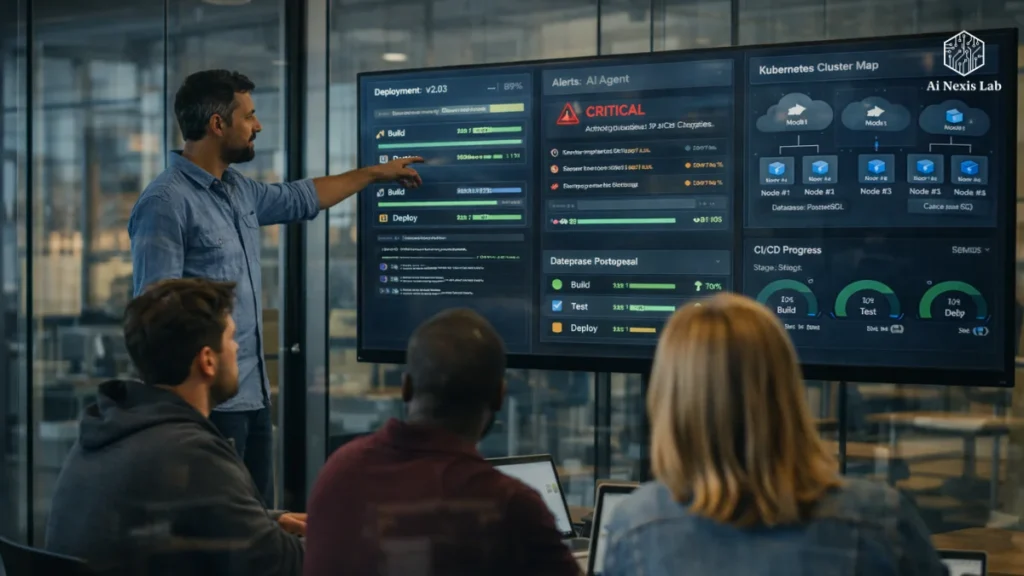
Self-healing pipelines
Traditional CI/CD behaves like a traffic light: pass or fail.
The agent behaves like a CI/CD mechanic:
- Something breaks.
- The agent analyzes the logs.
- It identifies possible causes.
- It proposes a patch – and applies it.
- It reruns the pipeline.
- It only alerts the human when it can’t actually solve the problem.
Failures become feedback loops – not bottlenecks.
2. The Five-Tier Architecture of an Autonomous Developer Stack
Building this type of stack doesn’t mean slapping a big LLM on your infrastructure.
The real power comes from specialization.
A strong ADS is built in layers – each one doing a job exceptionally well.
Level 1: Orchestration (Manager)
This is the planning brain. It doesn’t write the code. It decides who should do what.
The tools you will see will lead the way:
- Langgraph
- CruAI
- Microsoft Autogen
- Others are emerging quickly
Its job is to:
- Break the goal into integrated tasks
- Assign those tasks to the right agents
- See how the agents perform
- Manage iteration and development
Think of it as a project manager who keeps everything in sync.
Level 2: Logic and Intelligence (Engine)
These are the models themselves – and the big trend is model heterogeneity.
Use large models when decisions require nuance, design insight, or logic:
Then pair them with smaller, specialized models for raw coding speed and tight feedback cycles:
- Codelama Variants
- Deepseek-Coder
- Locally Optimized Models
Large Model Guide. Small models work faster.
That hybrid approach reduces costs, improves reliability, and keeps latency manageable.
Level 3: Context and Memory (Knowledge)
AI without context is like a new intern without onboarding.
To perform well, agents need:
- History of your codebase
- Conventions
- Documentation
- Past bugs
- Architectural decisions
- Onboarding notes
- Jira reference
That’s where Vector Database and RAG (Recovery-Augmented Generation) come in.
Tools like:
Allow the system to store and retrieve everything the AI needs – securely and intentionally.
Instead of looking for a “login system,” the agent looks at how yours works – and builds around it.
Level 4: Execution and Tooling (The Hands)
This is where the AI interacts directly with your environment.
- Local files
- Repositories
- Terminals
- Remote servers
- Cloud APIs
Through emerging standards like the Model Context Protocol (MCP), agents can:
- Read files
- Apply changes
- Commit PRs
- Trigger builds
- Analyze deployments
Headless IDEs — such as Cursor CLI or Cloud Code — give agents “eyes and hands” into projects without human clicks.
The result? End-to-end automation becomes stable and predictable.
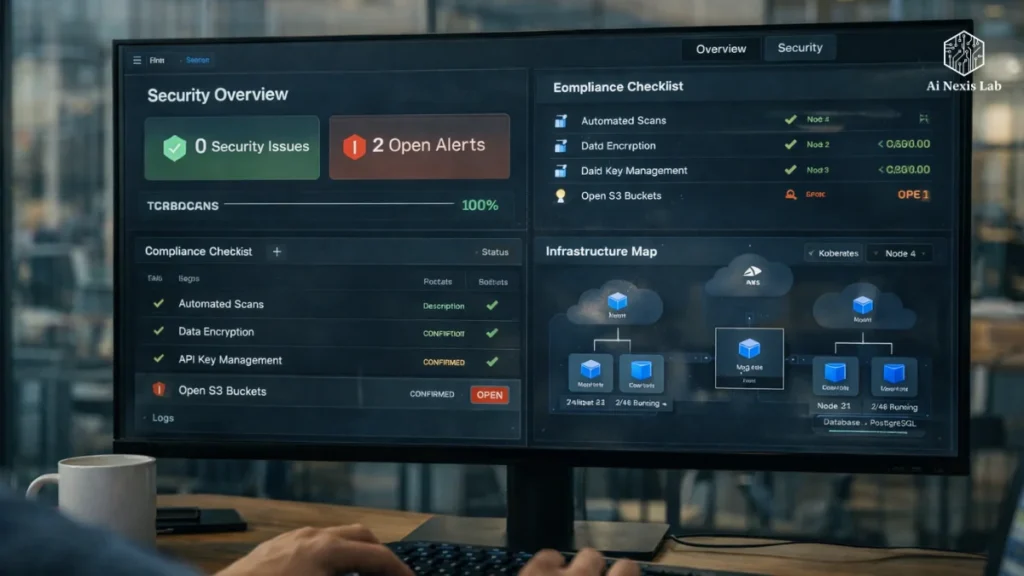
Level 5: Governance and Guardrails (Security)
Autonomy does not mean unregulated.
This level ensures:
- Compliance
- Security
- Reproducibility
- Approvals
- Auditable decisions
Guardrails may include:
- Policy as code (Sneak, Checksum, etc.)
- Automated security scanning
- Permission limits for agents
- Approval gates before production
The goal is not to slow down automation.
It is to make automation trustworthy.
3. Building Your Own Autonomous Developer Stack (Step-by-Step)
Now let’s talk about implementation.
If you’re leading an engineering organization today, here’s a step-by-step way to introduce autonomy without chaos.
Step 1: Standardize your context
Before empowering agents, give them clarity.
Start by indexing your repos. Tools like:
help extract readable context from the codebase.
Add a simple configuration file to each repo that explains:
- Naming conventions
- Code style rules
- Preferred frameworks
- Architectural patterns
- Known issues
Many teams use names like .ai_context or .cursorrules.
You’re basically writing an onboarding playbook – but for AI.
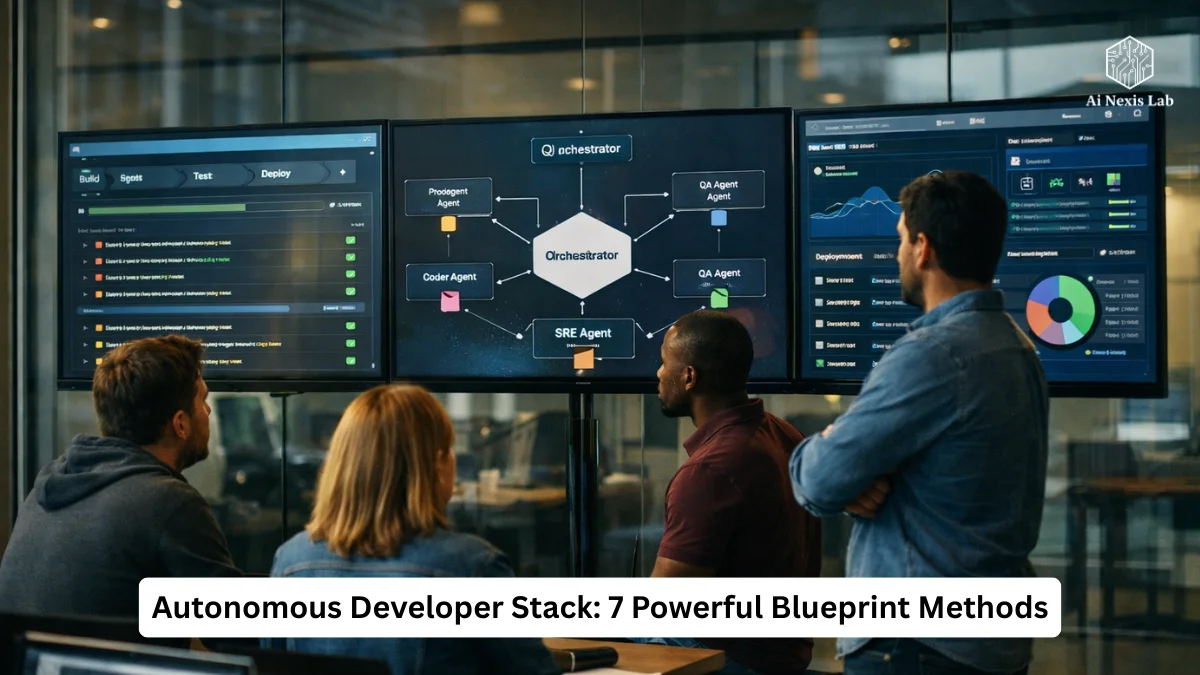
Step 2: Introduce a multi-agent workflow
Instead of one “mega-agent”, think squads.
Examples:
- Product Manager Agent → Interprets requirements or Jira tickets
- Developer Agent → Writes implementation
- QA Agent → Creates and runs tests
- SRE Agent → Prepares infrastructure code and deployment scripts
Everyone has boundaries and responsibilities — just like real teammates.
The magic happens when they collaborate around shared goals.
Step 3: Add self-healing CI/CD
A modern pipeline shouldn’t stop at failure.
It should be troubleshooting.
Your pipeline may evolve into:
- The build fails.
- The log analysis agent monitors the stack trace.
- Code refactor agent proposes fixes.
- Patches are automatically tested.
- The pipeline retries.
- The developer is only pinged if a fix fails repeatedly.
Humans focus on meaningful problems rather than mechanical triage.
4. Modern Tool Stack for 2026
If you were assembling your ADS today, here’s where to look.
| Category | Tools to watch | Why they matter |
|---|---|---|
| IDE / Editor | Cursor, Cloud Code, IDX | Built with AI as a first-class citizen and agent access. |
| Orchestration | Langgraph, Vellum AI | Designed for reliable multi-step agent workflows. |
| Observability | Langsmith, Honeycomb | Lets you debug not only application logs, but also agent logic. |
| Infrastructure | Pulumi, Winglung | High-level abstractions AI can safely manipulate. |
| Testing | Zentester, Cloudbees AI | Generates tests and predicts breakage before release. |
This ecosystem will evolve rapidly – but the direction is clear:
Tools are being redesigned so that AI can work natively within them.
5. Security in the Autonomous Age: Agentic DevSecOps
Here’s an uncomfortable truth:
If an agent can commit code, it can commit a backdoor.
That means security is not optional – it is fundamental.
Key guardrail strategies include:
Output Sandboxing
Never allow agents to run arbitrary code directly on production machines.
Use Docker containers, isolated environments, or controlled interpreters.
If something goes wrong, the damage is contained.
Shadow Linting and Scan
Before a human ever reviews AI-generated code:
- Security lint rules run
- Dependency checks
- Vulnerability scanners assess risk
Bad ideas are filtered out before they become PR.
Secret redaction
RAG systems should automatically remove:
- API keys
- Personal data
- Sensitive tokens
Before passing references to external models.
That reduces accidental leaks and keeps compliance intact.
Security moves to the left – and even becomes autonomous.
6. What happens to developers?
The question everyone is asking is:
“Does this replace developers?”
No.
But it completely changes what great developers do.
Instead of memorizing syntax, your value shifts to:
- Systems thinking
- Designing agent workflows
- Implementing governance and ethics
- Optimizing automation flows
- Ensuring business alignment
Three new roles are already emerging:
Orchestrator
Designs agent teams, workflows, and integration logic.
Governance Specialist
Ensures that policies, compliance, and approvals are built into the pipeline.
Context Engineer
Curates the documentation, references, and structured knowledge that agents rely on.
Developers become not only writers of code, but also architects of workflows.
7. The Way Forward
Adopting an enterprise developer stack is not a weekend project.
It’s a journey of maturity.
You start with:
- Automating tedious tasks
- Generating documentation
- Improving test coverage
Then gradually introduce:
- Multi-agent feature development
- Infrastructure automation
- Self-healing pipelines
Over time, the competitive advantage becomes clear:
It’s not about who has the biggest development team.
It’s about who has the smartest human-AI partnership.
The blueprint is here.
The tools exist.
And organizations that lean now will build faster, break less, and scale more predictably than their competitors.
It’s time to stop treating AI as an innovation.
Now it’s time to make adjustments.
Frequently Asked Questions (FAQ)
Q1: Does an autonomous developer stack mean fewer engineers?
Not necessarily. It means that engineers focus on more strategic work. Instead of writing boilerplate and chasing CI bugs, they design systems, validate decisions, and handle cases that AI is not ready for.
Teams can be more productive without shrinking.
Q2: How risky is it to let AI commit code?
It can be risky – unless you build strong railings.
With policy-as-code, sandboxing, automated scans, approval gates, and human oversight at critical points, risks can be managed responsibly. Treat agent permissions in the same way as human developer permissions – with stricter scopes.
Q3: Will this work for small teams and startups?
Absolutely – maybe even more than that.
Startups can:
1) Ship faster
2) Avoid hiring too early
3) Maintain lean engineering organizations
In many cases, ADS becomes a force multiplier for small, agile teams.
Q4: How long does it realistically take to adopt something like this?
Expect a phased rollout:
1) 1-2 months: Reference standardization and simple automation
2) 3-6 months: Multi-agent workflows and CI/CD enhancements
3) 9-18 months: Deep orchestration and self-healing pipelines
It’s iterative – and worth the patience.
Q5: What skills should developers start learning now?
The most valuable skills in this new world include:
1) Systems Design
2) Prompt and Intent Engineering
3) Governance and Compliance Thinking
4) Observability and Monitoring
5) Automation Workflow
Ironically, soft skills – communication, judgment, decision-making – are more important than ever.
Q6: Will AI ever completely replace manual programming?
Specific levels? Yes. Entire engineering teams? Highly unlikely.
Human insight is still important:
1) Ambiguous product decisions
2) Ethical trade
3) Creative architecture
4) Understanding user reality
AI builds. Human intent defines.
Q7: If companies are overwhelmed, where do they start?
Start small.
Automate documentation.
Automate test creation.
Automate code review assistants.
Once trust is built – add more depth.
The worst strategy is to ignore this change and let competitors move ahead first.