Beyond the Turing Test: Surviving the Age of AI-Powered Fraud (2026 Deep Dive)
AI Fraud guide for 2026: Learn 7 proven defense tactics to spot deepfakes, vishing, and scams. Practical steps to protect identity and finances now.
I still remember the first time I heard “my” voice say something I had never said.
It was 2024. A colleague texted me a 30-second audio clip. In it, “I” was describing a vacation to Italy that I never took. The pacing was right. A slight raspy sound in the back of your throat? Accurate. The awkward laugh I get when I’m not sure of a detail – it was there.
At the time, it seemed like a tech demo. Scary, but abstract. Something you’d show at a conference and say, “It’s wild what AI can do now.”
Fast forward to 2026, and the same technology is fueling a surge in global fraud measured in billions of dollars annually. Voice cloning, synthetic video, hyper-personalized phishing – this is not theoretical. It’s operational. And it is hitting regular people, small businesses, and Fortune 500 companies alike.
If you’ve ever experienced a half-second of doubt when you get a call from an unknown number… if you hesitate when your “CEO” gives you a quick wire break… if your stomach tightens when a relative calls in a panic late at night…
You’re not paranoid.
You’re adapting.
We’ve crossed a line. “Seeing is believing” is dead. “Hearing is believing” died with him. In 2026, authenticity is no longer sensory – it’s procedural. You don’t trust what you understand. You trust what you verify.
This is not fear-mongering. It is a field guide. We’re going to break down:
- How AI-powered fraud really works in 2026
- Why the old red flags don’t work anymore
- The psychology attackers exploit
- What practical defenses actually maintain
- And how to build your own human firewall
Let’s get into it.
Table of Contents
1. The Death of the “Red Flag”: Why Traditional Advice Fails in 2026
For years, cybersecurity advice was simple:
- Watch for typos.
- Check the sender’s email address.
- Don’t click on suspicious links.
That advice was wise in the era of low-effort spam.
It’s now outdated.
Generative Phishing: Precision at Scale
Modern phishing campaigns are powered by advanced large language models. These systems can:
- Imitate your company’s internal tone and formatting
- Reference real events from your LinkedIn, Instagram, or conference appearances
- Use correct grammar, full formatting, and contextually relevant details
This is often referred to as generative phishing – not attacks specifically designed for millions of people.
Here’s what’s changed:
| 2016 Phishing | 2026 Generative Phishing |
|---|---|
| Mass email blast | Individually researched target |
| Poor grammar | Flawless writing |
| Generic hook | Context-specific reference |
| Obvious sender mismatch | Spoofed domains + compromised accounts |
Attackers no longer have to guess. They scrape:
- Public social profiles
- Corporate press releases
- Data broker databases
- Lists of conference attendees
- Data from previous breaches
Then the AI assembles a custom message.
New Hook: Relevance
Imagine this email:
“Hey Chris, great to see you at the Austin Cybersecurity Summit last week. Following up on the Q3 migration vendor list you mentioned – attached is an encrypted PDF. The password is your employee ID.”
No typos.
Real event.
Real role.
Plausible urgency.
Completely fake.
The old “red flag” model assumes that the attackers were unprovoked. In 2026, the attacker is often an AI agent trained on millions of legitimate communications.
If you’re still relying on grammatical errors as your primary defense, you’re left exposed.
2. Vishing 2.0: When your “Mom” Calls for Money
Voice phishing – “Vishing” – has been around for years. But AI voice cloning took it from annoying to destructive.
AI Voice Cloning in 2026
With as little as 5-10 seconds of clean audio, modern voice models can generate:
- Real-time speech
- Emotions (fear, panic, urgency)
- Individual speech patterns
Public YouTube videos. Instagram stories. TikTok clips. Podcast appearances. That’s plenty of training data.
The most common attacks in 2026 fall into three categories:
- Emergency Family Scams
- Executive Impersonation
- Bank/Security Check Manipulation
Emergency Situation
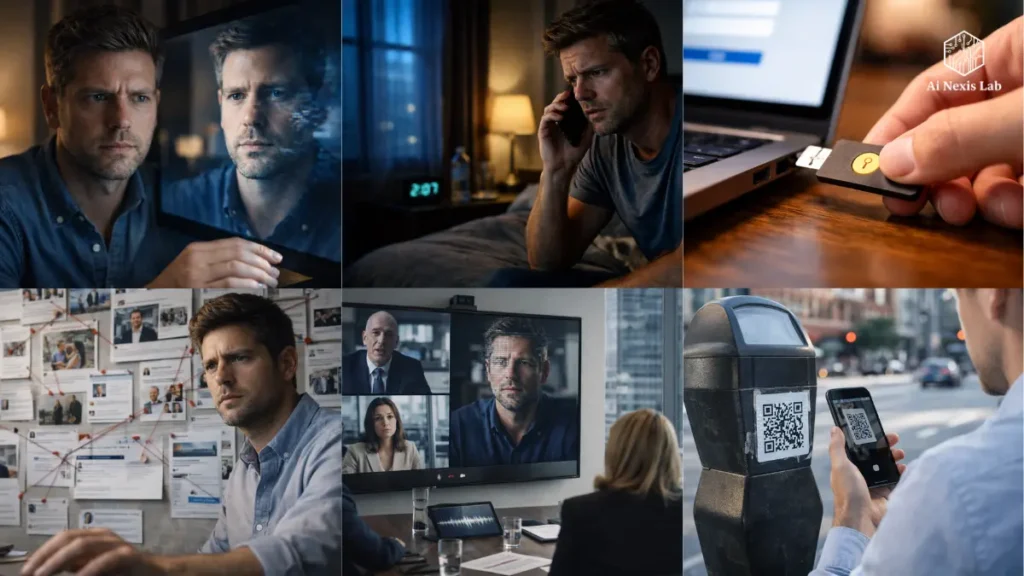
You get a call at 2:07 AM.
Your daughter is crying. She says she got into a car accident in Phoenix. She says she borrowed a friend’s phone. A “law enforcement officer” comes on the line and explains that a bond is required.
You hear her voice. You hear fear.
Your rational brain goes offline. The amygdala takes over. Fight-or-flight logic overrides.
You’re not thinking about artificial speech detection.
You are thinking: My child is in trouble.
This works because it targets emotions, not intellect.
Insider Tip: Safe Word Strategy
Every family needs a safeword. Not something obvious. Not your dog’s name. Not your hometown.
A random word or phrase that only your close circle knows.
Rules:
- It should not be stored in shared digital notes.
- It should be rotated every 6-12 months.
- It should never be used in public.
If someone calls claiming to be in trouble:
- Ask for a safe word.
- If they hesitate or ignore, end the call.
- Call a known number directly.
This single practice has prevented thousands of losses in 2026.
If you don’t have one, you’re gambling.
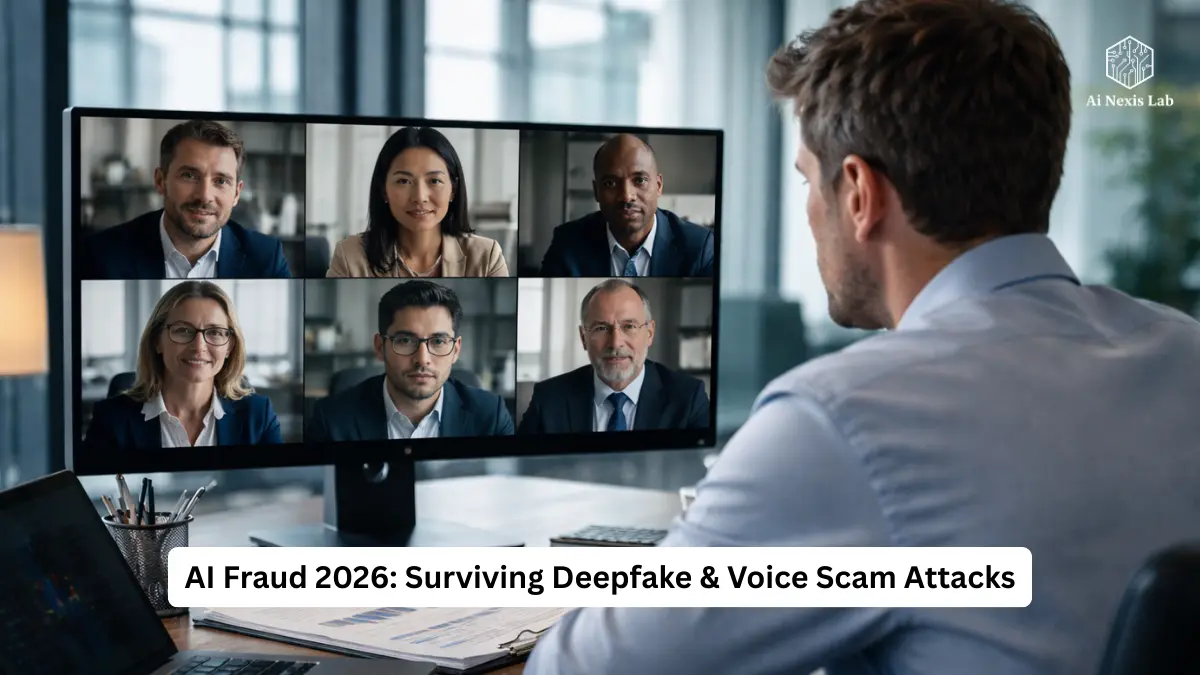
3. Deepfake Boardroom: $25 Million Video Call
If you think video makes you safer, you’re behind.
In a widely reported case in Asia, an employee transferred more than $20 million after attending a video call where several executives appeared on screen. There were layered artificial overlays on all real-time streams.
This is not Hollywood-level perfection.
It doesn’t have to be that way.
How Deepfake Meetings Work
Attackers use:
- Pre-recorded video data
- Real-time facial reenactment
- Synthetic voice overlay
- Compromised meeting links
They target:
- Finance teams
- Accounts payable departments
- Treasury roles
- Executives traveling internationally
Why finance teams? Because they have the authority and regular contact for major transfers.
Why Video Still Works
Humans are biologically wired to trust faces.
When we see:
- Eye contact
- Familiar gestures
- Recognizable voice patterns
We calm our suspicions.
AI exploits that bias.
The Weakness of “Liveness Tests”
You may have heard: “Tell them to turn their heads.”
It worked in 2022.
By 2026, real-time facial tracking could mimic head turns, blinking, and lip-syncing with high fidelity. It’s not flawless – but in normal business situations, it’s convincing enough.
Rescue is not visual testing.
It is a procedural test.
4. “Qrishing” and The Physical-Digital Blur
QR codes exploded during the pandemic. Contactless menus. Parking meters. Event check-ins.
In 2026, QR-based phishing – often called “Qrishing” – is one of the fastest-growing fraud vectors.
Why QR Codes Are Good For Attackers
- Users can’t visually verify the URL before scanning.
- Mobile browsers obscure full domain details.
- People assume that physical presence equals legitimacy.
Attackers:
- Print sticker overlays and place them over legitimate codes.
- Send a QR code via email disguised as an invoice.
- Use AI to create pixel-perfect clones of payment portals.
Malicious Overlay Trick
You park in the city. There’s a QR code on the meter. You scan it. The payment page looks similar to the city portal.
You insert your card.
Behind the scenes:
- The card is captured.
- AI scripts attempt fast high-value transactions.
- Fraudulent mules route funds through accounts.
The entire attack is complete before you get back to your car.
Physical doesn’t mean safe anymore.
5. Protecting Your Digital Identity: The New Rules of Engagement
Since your senses are unreliable, your defenses must shift from perception to systems.
Rule 1: Move to Hardware-Only 2FA
SMS-based two-factor authentication is weak in 2026.
Threats include:
- SIM swapping
- Social engineering carriers
- Real-time Vishing for codes
The upgrade is hardware-backed authentication.
Examples include:
- FIDO2 security keys
- Platform-based passkeys linked to secure enclaves
Requires:
- Physical possession
- Cryptographic challenge-response
AI can mimic your voice.
It can’t fake the USB security key sitting in your pocket.
If your financial accounts still rely on SMS codes, fix that this week.
Rule 2: Adopt a Zero-Trust Mindset
Zero trust does not mean paranoia. It means verification.
If:
- Your bank calls → hang up. Call the number on your card.
- Your CEO messages → Verify through another channel.
- A seller sends new wire instructions → Confirm via known phone number.
Never authorize money movements based on a single channel.
Never.
6. Problem Solving Techniques: Building Your Human Firewall
Technology alone won’t save you. Process will.
The OODA Loop for Fraud
Originally developed by military strategist John Boyd, the OODA Loop (Observe, Orient, Decide, Act) is ideal for detecting fraud.
Observe:
What feels urgent? What feels emotional? What doesn’t feel routine?
Orient:
Why this channel? Why now? Why me?
Decide:
Choose a verification path that bypasses the original channel.
Act:
Verify. Then move on – or end it.
The key is to slow down the loop. Scammers rely on speed and urgency.
Three-Channel Verification Rule
For any financial transaction:
- Channel 1: Request (email or message)
- Channel 2: Verification (known phone number)
- Channel 3: Confirmation (internal portal or digital signature)
If all three don’t align, no transfer occurs.
Make this a policy. Not a suggestion.
7. Future Impact: AI vs. AI
We are entering a period where even defense systems are AI-powered.
Emerging defenses in 2026 include:
- Artificial speech recognition algorithms
- Behavioral anomaly monitoring
- Device fingerprinting
- Continuous authentication systems
Your smartphone will soon:
- Can analyze vocal waveforms in real time
- Can detect anomalies in micro-expressions
- Flag deepfake risk scores during video calls
But these tools are not yet universal.
Right now, you are the final checkpoint.
The real digital divide is not within the reach of technology.
It is awareness of manipulation.
Common risks to avoid
| Pitfall | Why It’s Dangerous | 2026 Fix |
|---|---|---|
| Trusting verified badges | Accounts get hijacked | Verify intent, not icon |
| Reusing safe words | Eventually leaked | Rotate biannually |
| Oversharing online | Provides voice/video data | Restrict public exposure |
| Relying on SMS 2FA | SIM swap risk | Hardware-based auth |
| Acting under urgency | Amygdala override | Force 5-minute delay rule |
Add a five-minute pause rule for any urgent money requests. Emotion fades. Logic returns.
Frequently Asked Questions
Can AI really clone my voice in just 10 seconds?
Yes. In 2026, high-fidelity cloning models could produce convincing speech from extremely short samples. Ten seconds of clean audio is often enough to capture tone, pitch, and cadence. Longer clips improve accuracy, but minimal data can still produce something reliable in stressful situations.
The big issue isn’t perfect replication – it’s emotional credibility. In a chaotic or urgent situation, your brain fills in small inconsistencies. Attackers don’t need perfection. They need credibility under pressure.
If you have public videos, your voice is useful training data. That is reality.
Are password managers still secure?
Yes – with conditions. Password managers are one of the strongest defenses against credential stuffing and reuse attacks. The problem is not the treasury; The problem is how you secure it.
If your password manager only relies on a master password and SMS-based 2FA, it’s weak. It should be secured with a passkey combined with hardware-supported authentication or device-level cryptography.
Used properly, password managers significantly reduce risk. Used haphazardly, they become a point of failure.
How do I know if a video call is deepfake?
You may have noticed:
1) Slight lighting anomalies
2) Subtle facial edge artifacts
3) Eye movements that seem “flat”
But these signals are becoming harder to detect.
A reliable method is a challenge question or procedural verification. Ask something contextual and spontaneous that requires personal knowledge. Or better yet – shift to a secondary channel for confirmation.
A search based solely on visual defects in 2026 is unreliable.
Is AI-powered antivirus worth it?
Yes. Traditional antivirus relies on known malware signatures. AI-generated malware mutates quickly and does not match known patterns.
Behavior-based detection systems analyze:
1) File behavior
2) Network anomalies
3) Privilege escalation patterns
This approach catches new threats based on activity, not just signatures. It’s not perfect, but it’s significantly stronger against adaptive malware.
If your endpoint protection hasn’t been upgraded in years, it’s outdated.
Should I stop using QR codes completely?
No – but treat them like links from strangers.
Before entering payment information:
1) Check the domain carefully.
2) Avoid placing QR stickers over existing codes.
3) Choose to manually type in a known URL for high-value payments.
QR codes are tools. They are not inherently malicious. But trusting them blindly is.
Final Verdict
Trust has been reshaped by the intersection of AI and fraud.
You can’t rely on:
- Voice
- Video
- Email tone
- Verification badge
What works now is doubt and structure.
Slow down. Verify across channels. Upgrade authentication. Reduce public data exposure. Implement safe words. Require multi-channel confirmation for money movements.
In 2026, security is not about being tech-savvy.
It’s about being disciplined.
AI can imitate your face.
It can imitate your voice.
It can’t emulate your process – unless you have it.
And if you don’t have one, that’s the first thing to fix.