Trust Collapse: How AI-Based Fraud Is Forcing a Redesign of Personal Financial Security in 2026

Introduction: The Death of “Seeing is Believing”
Protect your finances in 2026 with 7 proven AI deepfake fraud defenses. Learn top identity theft prevention tips based on rising real-world threats and trends.
For most of human history, evidence meant physical presence.
If you’ve seen someone’s face, heard their voice, or seen them sign a document, you’ve accepted it as real. That assumption was the basis of law, banking, family relationships, and business transactions.
That assumption has now been broken.
By 2026, artificial intelligence has reached a frontier where identities can be reliably simulated in real time. Not perfectly, not flawlessly – but well enough to utilize human psychology. And that’s all criminals need. They don’t need complete deception. They just need you to hesitate for five seconds less than you do.
The result is a new fraud landscape where:
- Voices can be cloned from seconds of audio.
- Faces can be puppetized on live video.
- Emails, texts, and chat messages can be written in a person’s specific tone.
- Fake customer-service agents can conduct entire scam conversations autonomously.
This is not speculative. Documented financial fraud losses linked to AI-assisted impersonation have increased sharply since 2024, particularly in the following:
But here’s an uncomfortable truth that most articles won’t tell you:
AI didn’t invent fraud. It just removed the friction.
Scams that once required skilled social engineers now grow automatically. A teenager with a subscription to a deepfake tool could attempt attacks that previously required organized crime teams.
So the question is not “Will deepfakes ruin society?”
The real question is:
How do ordinary people build defenses that don’t require paranoia or technical expertise?
That’s what this guide is about.
No hysteria. No vague advice. Just actionable, layered defenses.
Part 1 – Understanding the real threat, not the Hollywood version
Let’s cut through the noise.
What AI Scams Can Really Do in 2026
Voice Cloning:
With short samples, modern models can reproduce rhythm, rhythm, and emotional tone. They still struggle with long unscripted conversations – but they don’t need to have an hour-long discussion to be successful. Thirty seconds of panic is enough to push a wire transfer forward.
Video Face puppeteering:
Real-time face mapping works reliably in:
- Low lighting
- Low resolution
- Short interactions
- Emotionally charged conversations
That’s exactly how scammers design their calls.
Text impersonation:
Large language models can study a person’s email history or chat logs and reproduce writing style with disturbing accuracy.
Autonomous scam agents:
Criminal groups are already deploying scripted AI agents that:
- Answer victim questions
- Adapt to their story
- Add emotional pressure when a human operator is not present for each conversation.
What AI scams still struggle with
Let’s not exaggerate:
- Full high-resolution live deepfakes are still fragile under bright light.
- Long free-flowing conversations often reveal inconsistencies.
- The complex real-world context is difficult for automated scam agents to maintain.
But again – scammers don’t need perfection. They need credibility over a long period of time to trigger action.
Part 2 – Why Human Psychology Is a Real Weakness
Here’s the harsh truth:
Most people don’t get scammed because technology makes them stupid.
They get scammed because emotions override verification.
The most common triggers:
- Urgency
- Fear
- Authority
- Family connection
AI just amplifies those triggers.
A fake crying daughter on a video call doesn’t have to look perfect. Under stress, your brain fills in the missing details. That’s biology, not stupidity.
So any effective defense must do one thing:
Force a pause between arousal and action.
Everything that happens is about creating that pause.
Part 3 – Five Layers of Protection That Actually Work
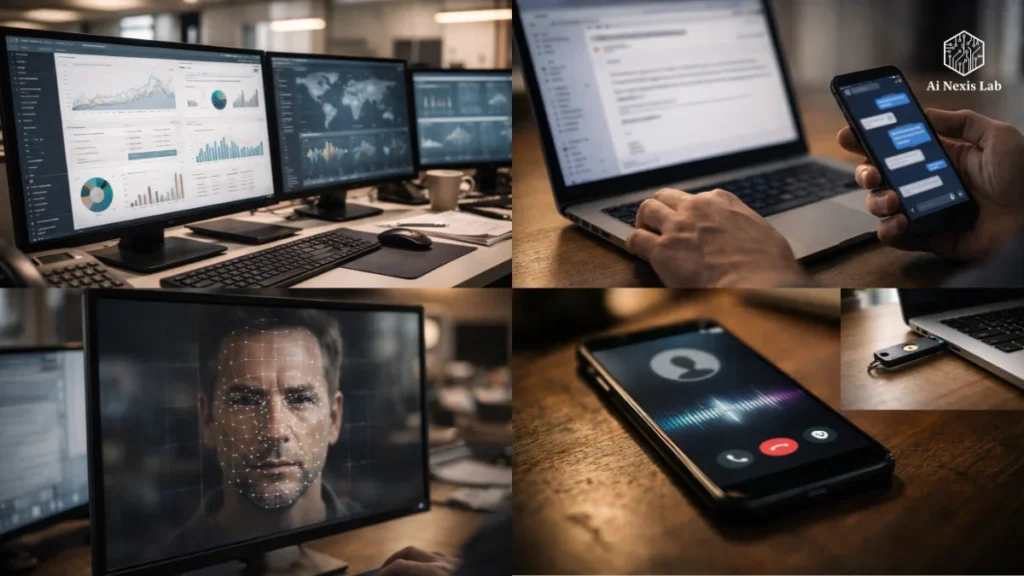
1) Family Safe-Word Protocol – Low-Tech, High-Reliability
This works for one simple reason:
AI can mimic your voice. It cannot guess a secret that has never been revealed.
Implementation rules:
- Choose a word or phrase that is not connected to birthdays, pets, or obvious themes.
- Never write it down in messages.
- Never store it in notes.
- Speak to each trusted family member in person once.
Usage Protocol:
If an emergency request for money or privacy appears:
- Ask for a safe word.
- If there’s hesitation or emotional outburst → assume fraud.
- No negotiation. No second chances. End the call.
The brutal truth:
If your real family member is truly in danger, they will understand the scrutiny.
Only scammers object to verification.
2) Hardware Security Key – Eliminating Remote Takeover Risk
SMS MFA is no longer enough. SIM swaps and real-time phishing pages bypass it every day.
Hardware keys (YubiKey, Titan, etc.) solve a specific problem:
They require physical possession to authenticate.
Even if:
- Your password is leaked
- Your email is phished
- Your session cookie is stolen
An attacker still can’t log in remotely.
Reality Check:
Yes, hardware keys are a bit inconvenient.
Yes, most people avoid them because laziness beats security.
But if you control:
- Bank accounts
- Crypto wallets
- Business payment systems
Then not using hardware keys in 2026 is simply negligent.
3) Multi-channel verification for high-value transfers
One channel is compromised.
Two independent channels are exponentially harder.
Operating rule:
If the request for money comes via:
- Email → Verify by calling a known number.
- Phone → Verify via messaging app.
- Video → Verify by another human contact.
Never verify in the same channel through which the request came.
This breaks down:
- Deepfake video scams
- Business email compromise
- AI voice imitation
Because scammers now have to control multiple independent identities at once.
Most don’t.
4) Reduce your public biometric surface area
Deepfake models need training data.
That data comes from your public content.
Important actions:
- Lock social media profiles.
- Remove old public videos wherever possible.
- Avoid posting long explicit voice recordings.
- Limit podcast or livestream exposure unless absolutely necessary.
This doesn’t make you invisible.
It only increases the attacker’s costs.
Security is not about not being hackable.
It’s about being too expensive to attack.
5) Bank-level identity verification that doesn’t rely on static biometrics
Modern banks are moving towards:
- 3D liveness detection
- Behavioral biometrics
- Transaction pattern anomaly detection
Just static face photos or voice prints are now considered weak – because deepfakes can spoof them.
You should ask your bank directly:
- Do you use liveness detection?
- Do you monitor for behavioral transaction anomalies?
- Do you support hardware key authentication?
If the answer to all three is no – your bank is behind current risk standards.
That’s not speculation.
That is the direction of the industry.
Part 4 – What’s Overhyped and What’s Real
Let’s cut through the hype.
Overhyped:
- “Perfect AI can flawlessly impersonate anyone.”
Not true. Deepfakes still break under controlled scrutiny. - “AI scams will replace all hacking.”
No. Traditional phishing and data breaches still cause the majority of damage. - “Blockchain identity solves everything.”
No. Most blockchain ID systems are immature and poorly adopted.
Real and current:
- AI reduces scammer skill requirements.
- AI increases scam scalability.
- AI increases credibility in emotional situations.
That’s a real risk profile.
Part 5 – What this means for asset protection
If you manage significant assets, the stakes rise:
- Large one-time transfers are prime targets.
- Family members become vectors of indirect attack.
- Business partners become targets of imitation.
So in 2026, asset security is no longer just:
- Firewalls
- Antivirus
- Password managers
It now includes:
- Human verification protocols
- Physical authentication devices
- Pre-agreed communication protocols
Security is no longer purely technological.
It is socio-technical.
Part 6 – Practical Implementation Checklist
No theory. Only action:
Within 24 hours:
- Set up a family safe-word.
- Purchase at least two hardware security keys.
- Lock down social media profiles.
Within a week:
1) Add hardware keys:
- Banking
- Crypto exchange
2) Set up multi-channel verification rules with family.
Within a month:
1) Ask the bank about:
- Liveness detection
- Behavioral fraud detection
- Hardware key support
2) Move funds if the answers are poor.
Ongoing:
- Treat the urge as suspicious.
- Verify before acting.
- Assume that any one channel can lie.
Part 7 – The Essential Psychological Discipline
Tools do not protect those who ignore them.
Real discipline:
- Slow down under pressure.
- Assume emotional manipulation.
- Default to verification.
Most victims of a scam later say:
“I felt something was wrong, but I didn’t want to seem rude.”
Being humble in 2026 is expensive.
Verification is not rude.
It is necessary.
Frequently Asked Questions
Q: Can Deepfakes perfectly copy my child’s face and voice?
A: Not completely. But enough to make you feel stupid for a while in stress and poor lighting. That’s all it takes for a scam.
Q: Is SMS MFA completely useless?
A: Not useless – but insufficient for high-value accounts. Think of it as a convenience level, not a security level.
Q: Are video calls reliable proof of identity?
A: No. Video is now a sophisticated medium. Think of it as a communication medium, not authentication.
Q: Will AI soon defeat all verification methods?
A: No. Physical possession, shared secrets, and cross-channel investigation remain strong.
Q: Should I stop posting photos online?
A: No. Just avoid overly public high-resolution video and long voice recordings.
Q: Are banks protected against deepfake fraud?
A: Some are. Many are not fully updated yet. Ask directly. If they avoid the question, assume weakness.
Q: Is crypto more vulnerable than banks?
A: Yes – because most crypto platforms still rely on weak authentication and irreversible transfers.
Q: Can scammers remotely bypass hardware security keys?
A: No. That’s precisely why they work.
Q: Do safe words actually work?
A: Yes – when they are private and consistently enforced.
Q: What if a scammer learns the word “safe”?
A: Then change it. Same as changing the password.
The ultimate reality check
We are not in a scientific dream.
We are in a transition period where:
- Identity can now be replicated.
- Trust must be earned, not assumed.
- Verification should be done regularly.
Those who adapt will be safe.
Those who rely on old assumptions will eventually be targeted.
This is not fear-mongering.
This is simple risk management.
Closing Thought
In 2026, the most dangerous phrase in personal finance is:
“I recognized his voice, so I trusted him.”
Belief is no longer verification.
Feeling is no longer evidence.
Sight and sound are no longer evidence.
The new rule is simple:
Don’t trust anything. Check everything.
Not because the world is broken –
but because the tools for fake reality are now cheap.
Adapt, and you’ll be fine.
Ignore it, and luck becomes your only defense.
And luck is not a strategy.