AI Copilots vs AI Agents: How They’ll Actually Work with Us in the Next Decade

AI Copilots vs AI Agents: Learn the real differences between AI Copilots and AI Agents, how they work together, key use cases, risks, and when to choose each to transform your workflow.
If you had asked most people a few years ago what artificial intelligence was “for,” you would have probably heard answers like: “automation“, “data insights“, or “making things faster“
Today, that conversation sounds different. It’s less about what AI can do, and more about how it will work with us – in our jobs, in our creative projects, and even in our everyday decision-making.
We have moved beyond innovative chatbots and strange experiments. AI has become a core part of how businesses operate and how individuals do real work. And in that growing ecosystem, two big ideas now sit at the center:
AI copilots and AI agents.
On the surface, these phrases sometimes seem interchangeable – especially because marketing teams like to blur the technical lines. But in reality, they represent two very different philosophies about automation and human control.
One is built around a partnership.
The second is built around delegation.
And understanding that difference will shape how you stay relevant in the years to come.
Part 1: Two Different Roles – A Partner vs. A Delegate (AI Copilots vs AI Agents)
Let’s start with the easiest way to understand the difference:
Who sits in the driver’s seat?
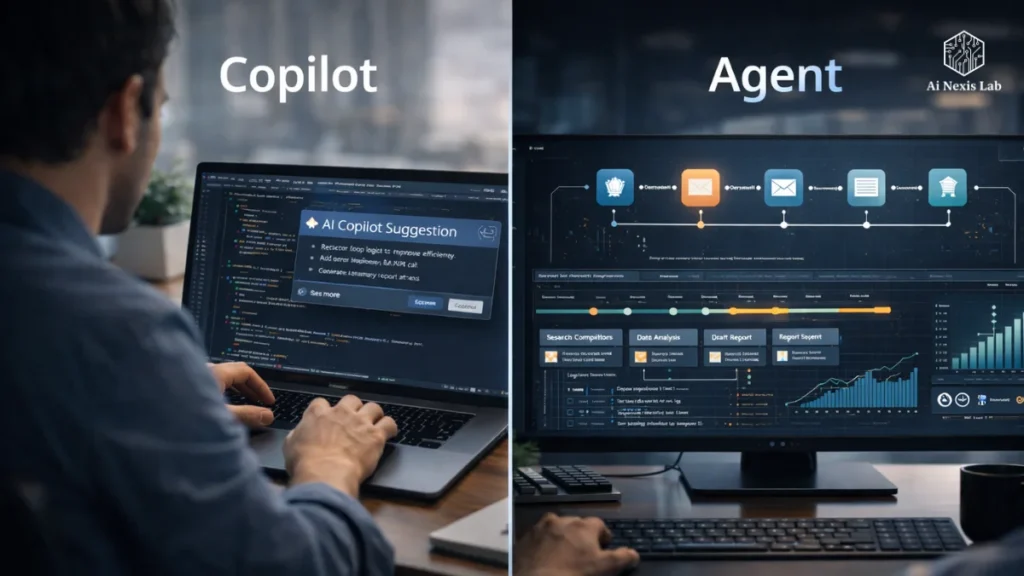
What is an AI copilot?
Think of the copilot in an airplane.
They are not ultimately responsible for every decision, but they are constantly there – assisting, advising, monitoring equipment, and helping when needed.
An AI copilot works in a similar way. It lives in the tools you already use:
- Your code editor
- Your email app
- Your note-taking software
- Your presentations, spreadsheets, and documents
It watches what you’re doing, understands context, and offers helpful hints:
- “Do I want to rewrite this more clearly?”
- “Here’s a snippet of code that completes what you started.”
- “This sounds like a task – should I add it to your to-do list?”
You remain completely in control. You approve. You edit. You decide.
This is often called a human-in-the-loop model, which means that the AI contributes ideas – but you make the final decision.
Key features of Copilot:
- Reactive: It reacts when you do something first.
- Suggestive: It suggests possibilities, not commitments.
- Embedded: It’s built into your existing tools.
Great examples include GitHub Copilot, Microsoft 365 Copilot, Notion AI, and dozens of editing assistants.
They don’t “run your workflow”. They sit next to you while you work.
What about AI agents?
Now imagine something different.
Instead of asking for step-by-step help, you give the AI a goal:
“Find out what our competitor changed their pricing last quarter and draft a Slack summary for the team”.
You submit.
The system is not waiting for further instructions. It:
- Opens tools
- Searches the web
- Pulls data
- Structures conclusions
- Writes summaries
- Sends them to Slack
And it does it all without constant hand-holding.
It’s an AI agent.
Where Copilot helps you think and create, Agent is designed to act on your behalf.
Core traits of an agent:
- Proactive: It can initiate tasks without your micromanaging.
- Autonomous: It figures out how to complete multi-step workflows.
- Goal-driven: You provide direction – it delivers results.
Instead of being locked into a single app, the agent moves freely between:
- Databases
- Browsers
- CRMs
- Messaging tools
- Analytics dashboards
It behaves less like software… and more like a digital assistant that can “learn the ropes”.
Part 2: Why Agents Represent a Major Architectural Change
To understand why agents seem like such a big leap, we have to look behind the scenes.
How Copilots Are Typically Built
Most copilots work like very advanced predictive text engines.
They look at the context:
“Here are the last 10 lines of code”.
Then they ask the underlying larger language model:
“Based on the same pattern, what comes logically next?”
They are brilliant at pattern-matching, but limited in scope.
Their “memory” is temporary – focused only on what’s on the screen or within the current conversation.
They don’t “decide” to open a new tool or take action elsewhere, unless you tell them to.
How Agents Are Different
Agents need real internal structure – closer to a miniature brain.
To work safely and independently, they will be able to:
1. Plan
Break down the big goal into logical steps:
“First get the data. Then sort it. Then analyze the patterns. Then craft the message”.
2. Remember
Gather short-term and long-term insights:
- Short-term: The task they are working on
- Long-term: Things like your preferences, format, tone, rules
3. Use tools
Call APIs, navigate apps, browse the web, and trigger automation.
4. Self-Improvement
Identify mistakes and try again – instead of just failing.
This architecture means that agents are not simply “smart autocomplete”.
They are more like digital workers.
A quick comparison
| Feature | AI Copilot | AI Agent |
|---|---|---|
| Interaction Style | Suggestions, Drafts, Edits | Goals, Tasks, Results |
| Autonomy | Low — Requires Constant Approval | High — Works Independently |
| Power | Writing, Brainstorming, Coding Help | Research, Logistics, Automation |
| Human Role | Pilot | Supervisor |
| Intelligence Type | Predictive | Reasoning + Action |
Both are powerful.
They simply exist to solve very different problems.
Part 3: What This Looks Like in Real-World Work
Let’s take a scenario: launching a marketing campaign.
Using the Copilot
You are still managing the strategy. You open your tools and tell Copilot:
- Draft a few email subject lines
- Summarize the research in bullet points
- Rewrite certain sections for clarity
Everything still goes through you.
You upload lists. You schedule emails. You hit send.
The copilot made your job easier – but you remained the operator.
Using an Agent
Now imagine you just say:
“Run a re-engagement campaign for users who have been inactive for 30 days”.
Agent:
- Queries the database
- Segments users based on behavior
- Generates personalized copy
- Checks links and formatting
- Creates campaign schedules
- Reports upon completion
Here, your role changes.
Instead of taking each step, you evaluate the strategy and the results.
And the future is heading in exactly the same direction.
Part 4: Why We Aren’t Completely Agent-Inspired Yet
If this sounds incredible, you might be wondering:
“So why isn’t everyone already using agents?”
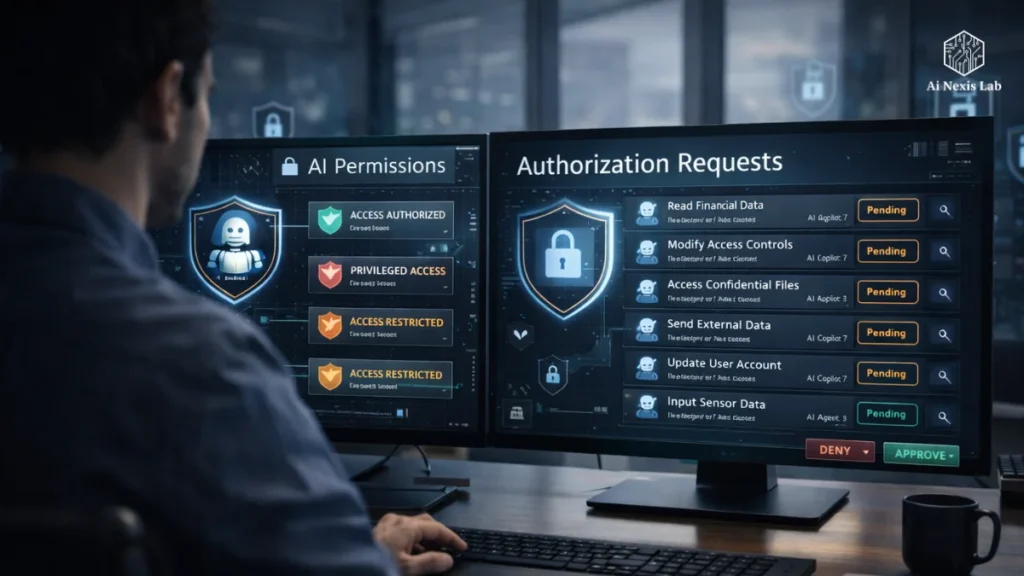
Because autonomy presents a risk.
The Trust Problem
If a copilot finds a false fact in a draft, you can catch it. No harm done.
If an agent makes and executes a bad decision, the consequences are immediate:
- Issuing the wrong refund
- Sending emails to the wrong audience
- Deleting or overwriting data
- Posting something publicly that shouldn’t be posted
It completely changes the safety conversation.
Security Challenges
To act on your behalf, agents need access to:
- Credentials
- Payment systems
- Internal applications
- Sensitive databases
Giving this level of permission to software introduces obvious vulnerabilities.
Companies are still looking for robust permission systems for AI.
The “Infinite Loop” Problem
Sometimes agents get stuck reasoning endlessly:
“Maybe try this… no… maybe that… wait… go back to step one…”
This uses up computation, money, and time.
It takes engineering effort to build reliable rails—which is why full autonomy has been slow to take off.
Part 5: Where are we really going — a hybrid world
The future may not look like this:
It would look like this:
Co-pilot who occasionally deploys agents when it makes sense.
Imagine you are writing a report and you tell your writing assistant:
“Get the competitor’s quarterly earnings, compare them to ours, and create a chart.”
Instead of doing it yourself, your co-pilot creates a temporary agent:
- Leaves documents
- Gets data
- Creates charts
- Returns
You still remain in control – but some parts of the work happen automatically behind the scenes.
That is the sweet spot that most companies are working towards.
So, who do you really need?
The answer depends on the nature of the work.
Choose a copilot when…
- Voice, tone, and creativity are important
- Ethical decisions are involved
- You need help thinking, writing, coding, or brainstorming
- You want suggestions, not commitments
Choose an agent when…
- The process is repetitive
- The steps rarely change
- The work is tedious but necessary
- Speed is more important than artistic subtlety
The real skill of the coming decade won’t be writing fancy prompts.
It will be orchestrating systems – deciding when humans will lead, when copilots will assist, and when agents will execute.
The Big Picture: From Work to Management
When tools become workers rather than helpers, our roles evolve.
We go from:
- Clicking every button
- Typing every command
- Juggling every small task
To something closer to:
- Designing workflows
- Establishing rules
- Reviewing results
- Making strategic calls
That doesn’t remove human value.
If anything, it increases the importance of:
- Decisions
- Vision
- Ethics
- Leadership
AI does not replace human meaning or responsibility.
It simply changes the place where our efforts are applied.
And the people who thrive will be those who learn how to manage digital collaborators – not just compete with them.
Frequently Asked Questions: About AI Copilots and AI Agents
Q1: Are AI agents going to replace human workers?
Agents won’t eliminate work – they will eliminate busywork.
They are designed to automate repetitive, rule-based tasks. Humans still handle:
1) Strategy
2) Final approval
3) Creativity
4) Complex problem solving
5) Emotional intelligence
Less “replacement” thinking, more role shifting.
Q2: Are AI copilots safer than agents?
Generally, yes.
Because copilots require constant human approval, they pose fewer risks.
Agents require strict security systems, as they can operate autonomously.
Q3: Can both exist in the same tool?
Absolutely – and it’s likely to become common.
Writing Platform:
1) Can use Copilot to help with drafting
2) Can use Agent to get research and format references
Same ecosystem, different responsibilities.
Q4: Do agents always do things right?
No — they are still learning systems.
They require monitoring, controls, and continuous improvement. That’s why “human supervisors” remain essential.
Q5: Should small businesses be concerned about this change?
More than anyone.
Small teams benefit the most from automation.
If a single founder uses agents thoughtfully, they can suddenly operate with the efficiency of a 5-person support team.
Q6: How can someone prepare for an AI-driven future?
Focus on skills that complement automation:
1) Systems thinking
2) Problem solving
3) Decision making
4) Communication
5) Creativity
Tools will come and go. These skills will be valuable.
Final Thoughts
We are entering a world where AI is not a novelty – it is an everyday companion.
Some systems will think with us.
Others will do the work for us.
Understanding the difference between a copilot and an agent isn’t just technical trivia – it’s a roadmap for how we’ll build businesses, shape careers, and design workflows in the next decade.
Those who learn to guide, monitor, and partner with these systems will not simply “stay on.”
They will lead.