Navy’s $448M AI Upgrade with Palantir Enhances Security
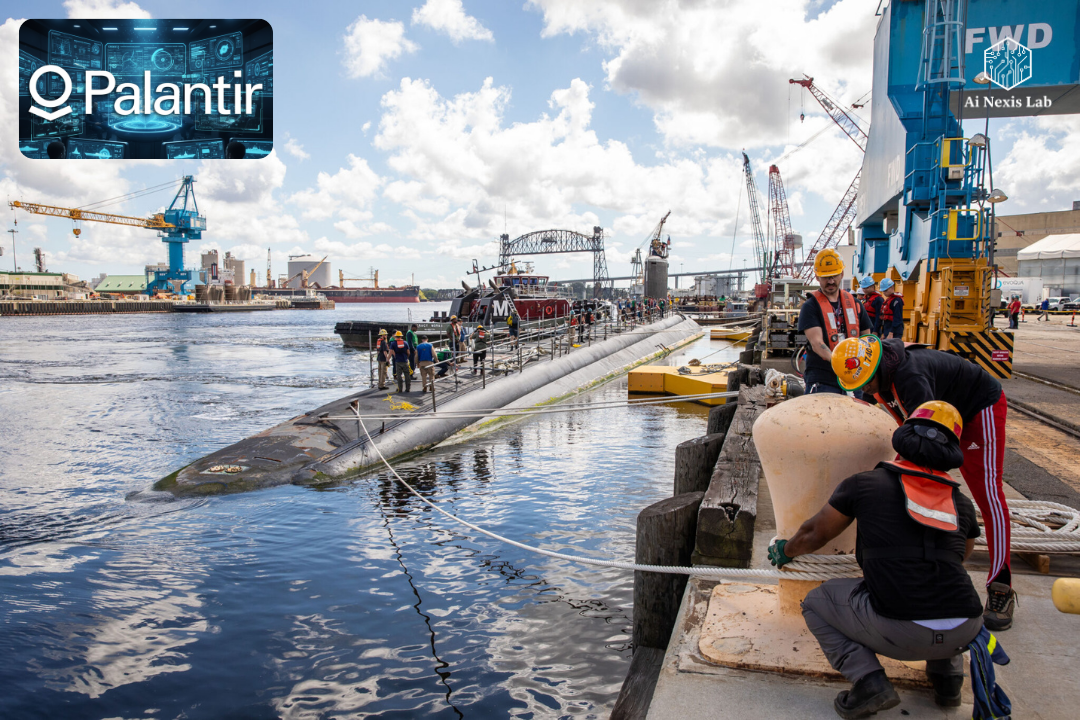
The Silent Revolution: How the Navy’s $448 Million AI Deal with Palantir is Rewriting National Security
The Navy’s $448 million AI contract with Palantir marks a major shift in Navy readiness. Find out how Ship OS is accelerating maintenance, reducing delays, and reshaping national security.
When most people think of military power, they imagine hardware.
F-35 jets soaring through the skies. Aircraft carriers shouldering the waves like floating cities. A submarine gliding silently beneath the sea, invisible yet deadly.
But here’s the uncomfortable truth:
- A ship that can’t leave dock is not a weapon.
- A submarine stuck in maintenance is no deterrent.
- The jet waiting at $2 Valve is just an expensive sculpture.
For decades, this silent problem – readiness – has been diminishing the power of America’s navy. Hardware has improved, technology has advanced, but the underlying systems that keep the fleet running remain painfully outdated.
The Navy’s new $448 million partnership with Palantir, and its AI-powered platform known as Ship OS, is an acknowledgement of this reality. It’s a turn – not flashy, not loud, but strategically huge.
This is the story of how data, software, and artificial intelligence are becoming as important as steel and gunpowder in an era of great power competition.
The Hidden crisis: A maintenance system that holds the fleet hostage
The U.S. Navy operates about 300 ships. Each of them is a marvel of engineering – a small city filled with machinery, electronics, weapons, and nuclear propulsion. Keeping all of this going is one of the most complex ecosystems on Earth to maintain.
And yet…
The System Is Clogged and Bleeding Time
Shipyards are overworked. Major repairs drag on. The maintenance backlog stretches from months to years.
The submarine overhaul, which was supposed to take 18 months, could slip to 36 months.
It’s not just paperwork – it’s strategic assets missing from the sea.
Imagine calling a timeout during a high-stakes game that lasted two years.
The problem is just as bad.
This decade of delays has earned the nickname:
- The Lost Decade
Billions of dollars of capacity are stranded in dry docks, not deployed at sea.
Why does everything take so long
Many problems have created this obstacle:
1. Outdated, Scattered Data
Maintenance information is scattered everywhere:
- Paper binders
- Excel spreadsheets
- Old databases
- Personal notebooks
- Engineers’ memories
No one person – or system – has the whole picture.
Figuring out why a part failed is a search using decades of disconnected information. Decisions are reactive, not predictive.
2. Supply chain fog
A ship can be stuck because of a missing part:
- a valve
- a seal
- a wiring harness
Where is it?
- Maybe in transit.
- Maybe on the shelf.
- Backordered for maybe six months.
This common delay has a terrible nickname:
“The part that eats the ship.”
Millions of dollars worth of equipment – froze because of a $95 component.
3. Shipyards are overloaded.
Skilled workers are retiring faster than their replacements.
The workload is overwhelming.
The schedules are chaotic.
No algorithm is planning the flow of people, equipment, parts, and dock space.
Until now.
Enter Palantir: The Digital DNA of the Fleet
Palantir is known for building systems that can take massive amounts of data and turn it into actionable intelligence.
They’ve done it for:
- Counter-terrorism
- Intelligence agencies
- Global commercial supply chains
Now they’re doing it for warships too.
The Navy is calling this platform:
- Ship OS
And it represents a quiet revolution.
What Ship OS Actually Does
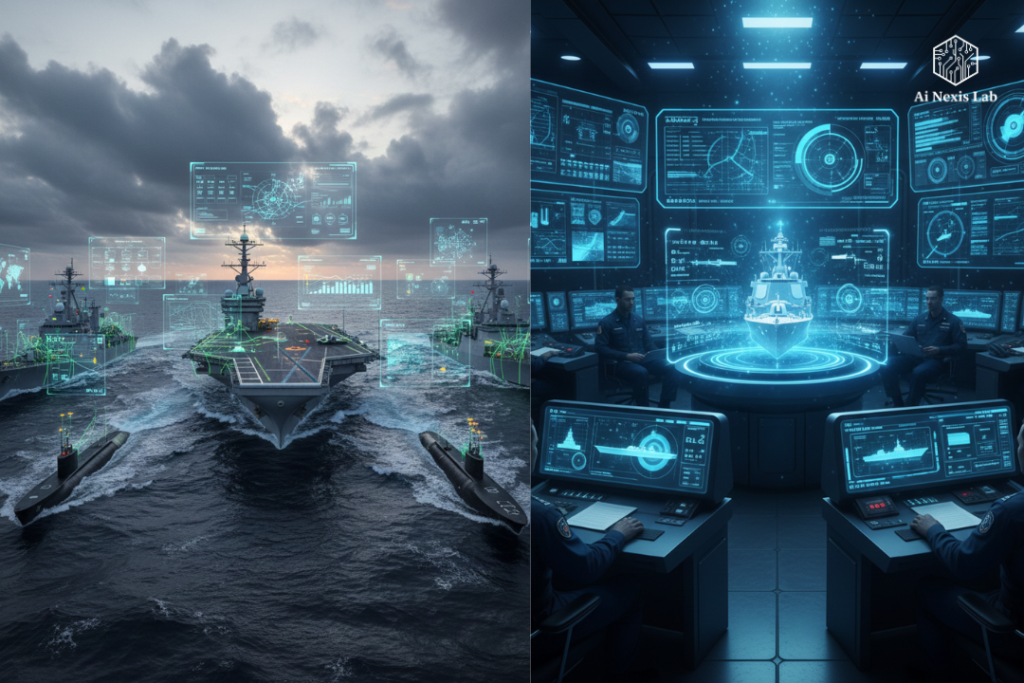
At its core, Ship OS aims to be a digital twin of every ship in the fleet:
- Every pump
- Every engine
- Every piece of steel
- Every maintenance operation
- Every supply chain part
All connected.
All analyzed.
All visible.
1. The Great Data Unification
Ship OS gets information from everywhere:
- Sensor data: vibration, heat, pressure
- Maintenance logs
- Supply chain databases
- Warehouse inventories
- Work order systems
- Shipyard schedules
Suddenly, something that was scattered becomes unified.
A pump is no longer just a pump – it is a data object that contains:
- History
- Performance trends
- Information sourcing
- Failure probabilities
This is new.
2. Predictive maintenance instead of guessing
Today, maintenance is either:
- Reactive — Fix it when it breaks
- Scheduled — Replace it after X hours
Both are expensive.
Ship OS presents:
Predictive Maintenance
Example:
The temperature of the gearbox has been rising slowly for weeks.
The AI notices.
It examines past failures from a single vendor.
It takes into account the ship’s recent operations in warm waters.
It predicts failures within 42 days.
The system recommends replacing the part before damage or downtime occurs during the next port visit.
This saves money, time and risk.
3. Dynamic scheduling and workflow
Shipyards work like a large orchestra. If one part is late, the entire schedule is disrupted.
Ship OS can:
- Change workers
- Prioritize different tasks
- Track materials in real-time
- Keep docks full and productive
No more idle crews.
No more wasting days.
No more waiting in lines.
Why This Is a Strategic Weapon
In great power competition, the equation is not simply:
More ships = more power
The real formula is:
- True naval power = ships × technology × preparation
Preparation is the secret multiplier.
A country with fewer ships – but more preparedness – could gain an advantage.
If the U.S. can get 5 more submarines back on patrol with less delay, the strategic difference is huge.
Cultural change: Human and artificial intelligence working together
Here’s the human side of the story.
Navy mechanics, welders, engineers, and sailors are incredibly skilled. Many have spent 20-30 years learning through experience and intuition.
Now they are being asked to trust:
- Dashboards
- Algorithms
- Probability charts
That’s a big leap.
The goal isn’t to replace human decision-making.
- It’s to augment it.
An experienced engineer who sees something that contradicts AI is still the most valuable voice in the room.
Ship OS needs to show its logic:
- Here are the 4 key indicators
- Here are the trends
- Here is the math
When humans understand why, they will adopt the system.
What could go wrong? Real risks
This project is huge. And there are legitimate fears.
1. Bad data = bad decisions
If workers miss steps or ignore accuracy, the models will be wrong.
The phrase “garbage in, garbage out” is a serious warning.
2. Cybersecurity
Ship OS will have:
- Maintenance schedule
- Readiness level
- Supply chain vulnerabilities
It is a treasure map for opponents.
It should be protected like a nuclear weapon.
3. Vendor lock-in
A single vendor controlling everything can be dangerous and expensive.
The Navy needs:
- Data ownership
- Modular components
- Interoperability
This should be a partnership, not a dependency.
Beyond Submarine: The Software-Defined Fleet
Currently, the platform is focused on submarines – the highest value targets.
But the vision is much bigger.
Shipbuilding will also change
Imagine a shipyard where:
- AI tracks construction in real time
- Delays are predicted days in advance
- Material flow is automated
- Welding sequences are optimized through simulation
That in itself is a revolution.
The Real Future: Autonomous Readiness
Every ship, every system, every sensor will eventually feed into the platform.
A commander will see:
- Ship location
- Mission status
- Estimated time on station
- Status of critical systems
- Supply chain constraints
In the future, readiness will not be reported – it will be known immediately.
It is variable.
Conclusion: The Power of Showing Up
The Navy’s $448 million deal with Palantir isn’t about software for its own sake. It’s about restoring the most fundamental requirement of naval strategy:
Being present when it matters.
In a world where deterrence is often silent and invisible, nothing sends a stronger message than:
- Submarines that deploy on time
- Carriers that complete maintenance early
- Ships that remain operational for longer
Sometimes the biggest weapon is just visible.
Ship OS doesn’t fire missiles.
It doesn’t launch aircraft.
But it ensures that the systems that do will be ready, reliable, and present.
And in the long chess match of global power, readiness may be the most crucial move.
Frequently Asked Questions
Q1: What is Ship OS?
Ship OS is an AI-powered platform developed by Palantir and the U.S. Navy. It unifies maintenance data, predicts failures before they occur, and optimizes scheduling and logistics across the entire fleet.
Q2: Why did the Navy invest $448 million?
Because maintenance delays cost:
1) Billions of dollars
2) Hundreds of operational days
3) Critical strategic preparedness
Ship OS is designed to reduce downtime and get more ships back to sea faster.
Q3: Does Ship OS replace human workers?
No.
It enhances them.
Humans still make the final decisions. The system gives them better information and clearer predictions.
Q4: Is this only for submarines?
Submarines are the first priority because they are high-value and highly complex. The long-term goal is to apply Ship OS to:
1) Surface ships
2) Carriers
3) Shipyards
4) Supply chains
5) Future shipbuilding
Q5: What about cybersecurity risks?
Centralizing this data means it has to be heavily secured. Cybersecurity is a key requirement of the platform. Any breach would be devastating, so security is built into every layer.
Q6: How does AI actually improve readiness?
AI can:
1) Detect early signs of failure
2) Predict when parts will break
3) Recommend optimal schedules
4) Improve supply chain visibility
This reduces downtime and keeps ships operational.
Q7: Is this a long-term change?
Yes. This is a fundamental step towards a software-defined military, where every asset is visible, measurable, and optimized in real time.