
Your bank is quietly stealing from you- here’s how smart savers are earning 5%+ APY in 2026.
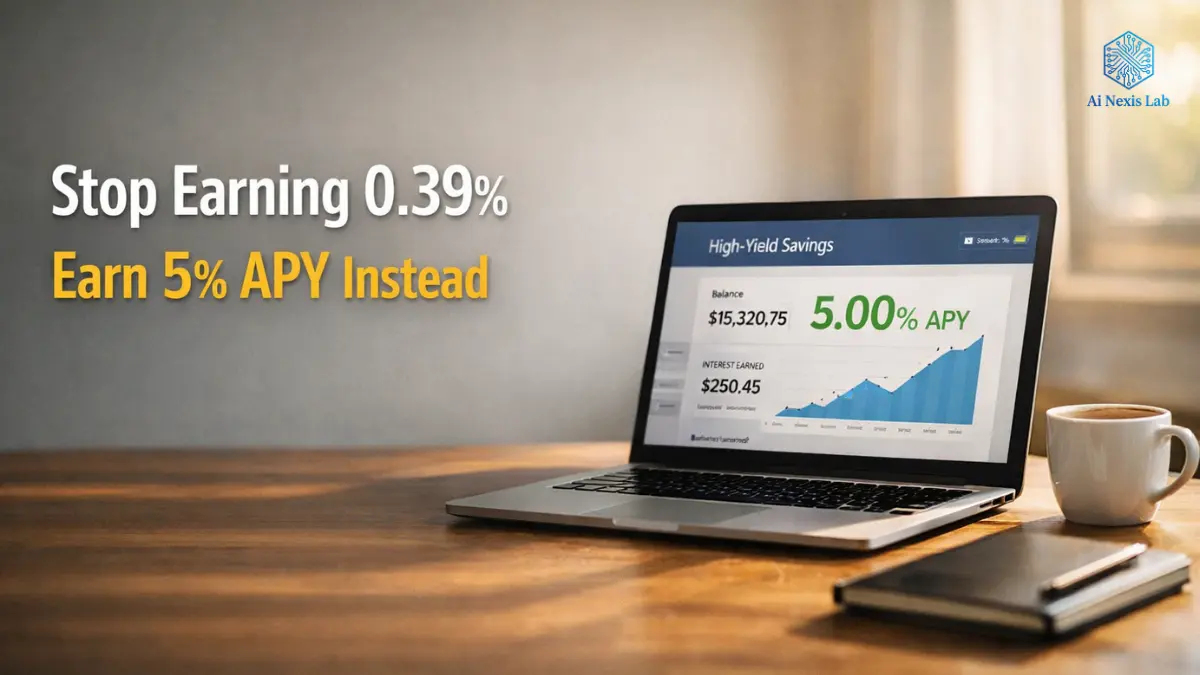
Discover 7 powerful high yield savings account options earning up to 5% APY in 2026. Stop losing money to low rates and maximize your savings now.
Table of Contents
Introduction: The Quiet Tax You’re Probably Ignoring
Let’s cut through the noise.
If your savings account is currently at a traditional bank, you’re probably earning between 0.01% and 0.50% APY. It’s not just low – it’s borderline useless.
As of April 2026, the national average savings rate is about 0.39% APY. Meanwhile, banks are lending that same money at 7%–20%+ through mortgages, personal loans, and credit cards.
This difference?
It’s not a coincidence. It’s the business model.
You are effectively subsidizing the bank’s profits by accepting terrible returns.
Now here’s the uncomfortable truth:
You don’t have to play that game.
FDIC– and NCUA-insured accounts are currently paying 4%–5%+ APY. Same safety. Same basic function. Completely different outcome.
Let’s put some real numbers on it:
- $25,000 at 0.39% → ~$97/year
- $25,000 at 5.00% → $1,250/year
That’s a difference of over $1,150 per year for doing nothing but moving your money.
If you’re still sitting in a low-rate account, you’re not being careful – you’re being passive. And it’s costing you money.
2026 Rate Climate: Why Time Still Matters
What’s Changed Since 2025?
Here’s the reality that most people miss:
- The Federal Reserve cut rates three times in late 2025
- Savings rates followed suit (because they always do)
- Top APYs fell from ~5.5% → ~4.0–5.0% range
Early 2026:
- The Fed has paused rate cuts
- Markets expect a possible cut later in the year
- Current rates are stable but not guaranteed
What This Means For You
Waiting won’t help you.
You’re not timing the market here – you’re deciding whether to:
- Earn 0.39% now, or
- Earn 4-5% now
Even if rates fall later:
- 4% is still 10 times better than the big banks
- The gap doesn’t disappear – it just narrows a bit
So the question isn’t “Will rates fall?”
The question is: “You’re earning almost nothing today?”

7 Best High-Yield Savings Options Right Now (2026)
1. Varo Bank – Up to 5.00% APY
Best for Small Balances + Direct Deposit Users
Key Details:
- 5.00% APY up to $5,000
- Drops to ~2.50% above that
Requires:
- $1,000/month direct deposit
- Active account usage
Reality Check
This is a targeted optimization tool, not a complete solution.
If you can meet the requirements:
- You squeeze the maximum yield out of your first $5K
If you can’t:
- It’s just another average account
Bottom line:
Great – but only for specific use cases.
2. Consumers Credit Union – Up to 5.00% APY (Checking)
Best for: People who are willing to actively manage their accounts
Key details:
- 5.00% APY on up to $10,000
Requires:
- Debit card use
- Direct deposit
- Account activity
Honest Take
This is not inactive.
If you’re lazy about money management, you’ll:
- Miss out on requirements
- Miss out on rates
- Waste of time
But if you’re disciplined:
- This is one of the highest-yielding setups available
3. PiBank – 4.60% APY (no strings attached)
Best for: People who hate complexity
Key details:
- No minimum balance
- No direct deposit requirement
- No monthly fees
Why This Matters
Most people overcomplicate things.
PiBank is:
- Open an account
- Deposit money
- Earn ~4.60%
No tricks. No hoops.
For 90% of people, this is the smartest default option.
4. Axos ONE® – Up to 4.21% APY
Best for: All-in-one banking setup
Key features:
- Strong savings rate
- Competitive checking APY
- Large ATM network (95,000+)
Reality
It’s all about the convenience + yield balance.
If you want:
- One login
- One system
- Proper compensation
This works.
If you want maximum optimization:
- It’s not absolute best
5. CIT Bank Platinum Savings – Up to 4.10% APY
Best for stable, high balances
Critical details:
- Below $5,000 → ~0.25% APY
This Is Where People Get Confused
They see:
“4.10% APY”
But ignore:
“Only if balance stays above $5,000”
Getting below that?
You basically revert to big bank rates.
This account rewards discipline – and punishes carelessness.
6. NewTech Bank – 4.20% APY (waitlist)
Best while available
Currently:
- Not accepting new applications (as of April 2026)
- Overwhelming demand
Why It Matters
This account shows what people really want:
- High rates
- No terms
- No balance tricks
Whenever it reopens:
- Expect a flood again
7. My Banking Direct – ~4.00%+ APY
Best to use: Easy + stable option
Key points:
- $500 minimum to open
- No ongoing requirements
- Backed by Flagstar Bank
Straight Talk
Not attractive. Not trendy.
Just consistent and solid.
Insider Truths Banks Don’t Want You to Pay Attention to
1. APYs are Variable
Rates can change at any time.
If you don’t check:
- You’re blindly accepting whatever they give you
2. FDIC Insurance Isn’t Unlimited
- $250,000 per depositor per institution
- Joint accounts increase coverage
If you have a large cash pile:
- You need a strategy, not assumptions
3. Transfers Are Slow
ACH transfers:
- 1–5 business days
If you move everything:
- You risk liquidity problems
4. Interest Is Taxed
That 5% yield?
After taxes:
- Closer to ~3.5–4% depending on your bracket
Still good – but don’t ignore reality.
5. “High Yield” Is Often Misleading
Some Accounts:
- Pay High Rates Only on Small Balances
- Drop Heavily After a Threshold
Always Read the Full Rate Structure.
Money Multiplier Structures (This Is Where You Really Win)
1. Rate Gap Audit
Stop guessing. Do the Math.
Steps:
- Look at the interest for the last 12 months
- Recalculate at 4.5%
- Compare
That difference = your lost money
For most people:
- $500–$1,200/year wasted
That’s not small.
2. Qualifier Stack Method
Instead of choosing one account:
- Split direct deposit
- Meet multiple requirements
- Maximize multiple high rates
Same money. Better Structure.
3. Split-Bucket Strategy
Not all savings should stay in one place.
Example:
- Emergency Fund → PBank
- Spending + Checking → CCU/Exos
- Long-Term Reserves → CIT
Every dollar has a job.
4. Rate Expiration Tracker
Promo expires. People forget.
Fix:
- Set calendar reminder for 5 months
- Recheck rates
- Move if needed
This alone saves hundreds each year.
5. FDIC Shield Optimization
If you have serious cash:
- Spread across institutions
- Use joint accounts
- Maximize insurance limits
This is basic risk management – not optional.
Common Mistakes That Kill Your Returns
Ignoring Minimum Balance Rules
You Get Down → Your Rates Get Lower
Misunderstanding “Direct Deposit”
Not All Transfers Qualify
Chasing Promo Rates Without Tracking
Banks Rely on Your Laziness
Moving All the Cash at Once
You Lose Liquidity
Doing Nothing
This is the Biggest
Where Rates Lead (Reality, Not Hype)
Let’s Be Honest:
- Rates Are Likely to Drop a Little in 2026
- Maybe From a Range of 5% → ~4%
But Here’s the Part People Misunderstand:
Even at 4%:
- You’re Still Outperforming Traditional Banks on a Massive Scale
The System Ensures:
- Online Banks Always Pay More
So Again – Waiting No point.
How to Open an Account (No Excuses)
- Choose an Account
- Apply Online (10 Minutes)
- Link Your Bank
- Transfer Money
- Set Reminders
That’s it.
It’s not complicated.
Frequently Asked Questions
Is my money really safe in these accounts?
Yes – assuming the account is FDIC or NCUA insured.
That means:
1) Up to $250,000 is protected per institution
2) Even if the bank fails, your money is covered
This isn’t theoretical – it’s been tested in real bank failures.
Will these high rates disappear soon?
It will fluctuate – but it won’t disappear overnight.
Rates are as follows:
1) Federal Reserve Policy
2) Market Competition
Even if rates fall:
1) Online banks will still be significantly ahead of traditional banks
The real risk is not a rate cut – there is nothing to be gained while waiting.
Can I lose money in a high-yield savings account?
Not in terms of principal.
Your balance will not decrease until you make a withdrawal.
The only “disadvantage” is:
1) Inflation is higher than your returns
But at 4-5% APY:
1) You are still ahead of inflation under most current circumstances
Is it really worth trying to switch accounts?
Yes – and it’s not even close.
Example:
1) $20,000 at 0.5% = $100/year
2) $20,000 at 4.5% = $900/year
That’s a difference of $800.
Account opening time: ~15 minutes
It’s one of the highest ROI steps you’ll ever take.
How often should I review my savings setup?
At least:
1) Every 3-6 months
Also check:
1) After Fed rate changes
2) When promo periods expire
If you’re not reviewing:
1) You’re slowly moving towards lower returns
The Final Verdict: Stop Accepting Bad Deals
Here’s a simple truth:
Your bank won’t:
- Raise your rates fairly
- Notify you when better options exist
- Make the best use of your money
That’s your job.
And now:
- The difference between doing nothing and doing something is hundreds to thousands per year
This is not an investment.
This is not a risk.
This is basic financial hygiene.
Pick an account. Move your money. Done.
One Last Push (Because You Probably Still Won’t Act)
You’ve read this far.
So don’t:
- Bookmark it
- Think about it
- Come back later
People get stuck earning 0.39%.
Instead, do this:
- Open an account today
- Move at least some of your savings
- Set a reminder
That’s it.
You don’t need perfection – you need movement.
Because right now?
Your money is not working.
And it’s up to you.
Disclaimer:
APY and account details are accurate as of April 2026 and are subject to change. Always verify current rates directly with the financial institution before opening an account. This article is for informational purposes only and is not financial advice. All accounts mentioned are FDIC or NCUA insured, but confirm insurance status for your specific situation at FDIC.gov or NCUA.gov.