Clicks are hiding in the machine: Why your YouTube strategy needs an AI overhaul in 2026
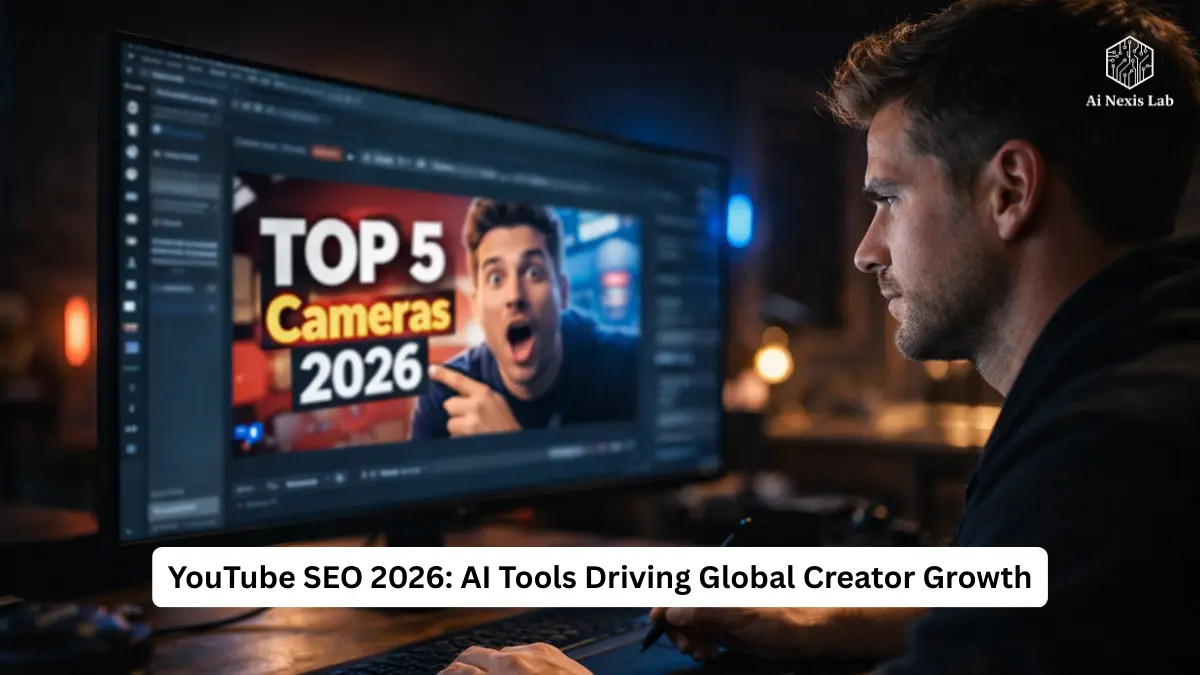
Discover 5 proven AI-driven YouTube SEO tools and keyword strategies for 2026 that boost search visibility, CTR, and long-term algorithm growth.
It’s 2:07 a.m. Your coffee has gone cold. You have a solid idea – maybe it’s a breakdown of the 2026 EV tax credit changes, maybe it’s a deep nostalgia dive into Cartoon Network’s late-’90s lineup – but the cursor is blinking as if it’s judging you.
You are not stuck for not being creative.
You are stuck because the process is overwhelming.
Scripting. Editing. Designing a thumbnail that doesn’t look like 2014 clickbait. Researching keywords. Chasing retention. Tweaking titles. Re-exporting. Re-uploading.
That’s where most creators burn out. Not on ideas. On friction.
Here’s the plain truth: In 2026, if you’re still manually pushing YouTube, you’re choosing the hard way. The top 1% are not “more motivated”. They are using AI as infrastructure.
Not as a gimmick.
Not as a crutch.
As a system.
This is not about changing your creativity. It’s about removing the drag that’s slowing it down.
Let’s break down what it really looks like.
Table of Contents
2026 Reality Check: YouTube Is a Data War, Not a Talent Show
Before we get into the tools, let’s reset your mental model.
YouTube in 2026 is:
- More competitive than in 2023
- More global than ever
- More AI-assisted on the backend
- More brutal about retention
The algorithm doesn’t care how long you edited.
It cares about:
- Click-through rate (CTR)
- Average view duration (AVD)
- Viewer satisfaction signals
- Session time contribution
- Multilingual reach
And here’s the kicker:
Most creators are still optimizing emotionally, not strategically.
They “feel” that the hook is strong.
They “think” the thumbnail looks good.
Top creators? They test. They simulate. They model behavior.
That’s where the AI stack comes in.
1. The Death of the Blank Page
The blank page is not a problem for creativity.
It’s a structural problem.
Most people sit down and try to write a complete script from scratch. It’s inefficient. In 2026, you should never start from scratch.
You start with a framework.
Then AI helps you pressure-test it.
Subscribr: Turning Your Own Videos into a Script Engine
Subscribr is not your typical chatbot. It is designed specifically for YouTube creators.
The difference?
It learns from your data.
Here’s how serious creators use it:
Step 1: Feed It Winners
Upload transcripts of:
- Your highest retention video
- Your highest CTR video
- Your fastest growing video
The tool analyzes:
- Hook style
- Sentence pace
- Average sentence length
- Changes in emotional intensity
- Retention heatmap spikes
It’s not guessing your voice. It’s modeling it.
Step 2: Create Structure, Not Fluff
Instead of saying:
“Write me a video about budget cameras.”
You say:
“Create a 10-minute retention-optimized structure for ‘Best Budget Camera 2026’, using curiosity-driven hooks and pattern interrupts every 60-90 seconds.”
You are not changing yourself now. You are generating scaffolding.
Then you inject personality.
If you let AI write everything untouched, you deserve mediocre results.

Juma (Formerly Team-GPT): For Those Who Want Control
If the subscriber is well-organized, Juma is modular.
Power users love it because it lets you:
- Combine multiple AI models
- Pull live web data
- Run SEO passes
- Layer rewriting filters
- Create reusable workflows
Example:
You’re making a video titled:
“Best Budget Cameras Under $500 (2026)”
You can:
- Pull real-time Amazon pricing
- Cross-check B&H inventory
- Extract review sentiment
- Make it a story about a broke novice filmmaker
- Optimize the title for YouTube search
- Generate 20 hook variations
- Rewrite it at an 8th grade reading level for clarity
All in one chain.
That’s not cheating. That’s leverage.
Hook Engineering: Stop Accepting the First Draft
This is where most creators get lazy.
They create a hook.
They use it.
Wrong move.
Ask for 15 variations in psychological triggers:
- Curiosity Distance
- Fear of Missing Out
- Adversarial Who
- Power Position
- Loss Aversion
- Change Promise
Then test it.
Your hook is not “writing.”
It’s a conversion device.
2. Thumbnail Chemistry: From Hobby Look to Netflix-Level Clicks
Let’s be clear.
If no one clicks, your video doesn’t exist.
In 2026, the CTR is stricter than ever. The average homepage is full of:
- Cinematic lighting
- Bold, minimal text
- High-contrast composition
- Emotionally clear focal point
An old, wide-mouthed grieving face? Saturated.
Now it’s all about the polish.
Canva Dream Lab: Style Transfer Without Design School
Canva’s Dream Lab integration changed the game.
You can now:
- Upload reference thumbnails
- Extract lighting styles
- Copy color grading
- Create custom environments
- Immerse yourself in cinematic scenes
Imagine you’re in tech.
Instead of a cluttered desk background, you generate:
- A futuristic lab
- Neon edge lighting
- Dimmable depth of field
- Controlled color palette
Then you simplify the text to a maximum of 2-4 words.
Because here’s the reality:
If it’s unreadable on a 5-inch phone screen, it’s dead.
Pikzels: Speed for Trend-Driven Niches
If you’re into:
- Gaming
- Tech News
- Celebrity Commentary
- Finance Updates
You don’t have days to design.
Pixels analyzes trending thumbnails and suggests layout structures.
But here’s the catch:
If you copy blindly, you’ll get mixed up.
Use it for layout logic.
Have your own brand color identity.
3. Retention Is a Real Game
You can fake CTR.
You cannot create a time frame for fake views.
In 2026, YouTube prioritizes:
- Average view duration
- Percentage watched
- Rewatches
- Session retention
You need to design for retention before you create a film.
Spotter Studio: Structural Retention Planning
Spotter Studio helps you identify “dead zones”.
Dead zones are:
- Long explanations
- Overly linear storytelling
- Predictable pacing
- No scene transitions
It suggests:
- Pattern interruptions
- Visual breaks
- Narrative pivots
- Cliffhanger mini-hooks mid-video
The difference between 42% retention and 58% retention is usually structural – not personality.
The 15-Second Rule
Your first 15 seconds should:
- Promise results
- Create surprise
- Remove suspense
- Avoid long intros
No:
“Hey guys, welcome back to the channel.”
Nobody cares.
Tell them what they will get.
Why is that important?
Why now?
Move on.
4. The First 10,000 Subscribers Blueprint
Stop trying to “grow”.
Solve the pain.
Gap Analysis Method
Use vidIQ to find:
- High search volume
- Low quality score competition
- Underserved topics
Then create the best answer.
Not the fastest answer.
TubeBuddy still wins for thumbnail A/B testing.
If you’re not testing thumbnails in 2026, you’re guessing.
Workflow Automation Hooks
People don’t want tools.
They want time back.
Instead of:
“Here is the description.”
Say:
“I reduced editing from 20 hours to 2 hours.”
That is transformation framing.
Ethical AI Positioning
There is a backlash against AI content farms.
Position yourself differently:
- Show your process
- Explain your edits
- Show human polish
- Avoid robotic voiceovers
Use AI as an assistant, not a mask.
5. The Global Creator Era
By the end of 2026, video generation and language scaling are exploding.
Text-to-video quality is moving towards cinematic reality.
Add to that:
- AI dubbing
- Voice cloning
- Lip-sync translation
Small creators can now publish in:
- English
- Spanish
- Portuguese
- Japanese
Without filming twice.
That means your market is no longer “Ohio.”
It is global.
If you’re not thinking multilingual by 2026, you’re playing small.
Hybrid Creator Model
The future of AI is not going to replace it.
It is humans who understand systems that do not understand humans.
Your edge is:
- Taste
- Decisions
- Story
- Authoritative perspective
AI handles:
- Drafting
- Formatting
- Transcription
- Background removal
- Data scraping
- Thumbnail rendering
- SEO structuring
If you’re still doing all the mechanical work manually, you’re choosing inefficiency.
Frequently Asked Questions
Will YouTube penalize AI-generated scripts?
No.
YouTube evaluates behavioral signals:
1) Watch time
2) Click behavior
3) Engagement
4) Viewer satisfaction surveys
In some contexts, especially in altered content, they require disclosure for actual AI-generated visuals. But there are no penalties imposed for using AI to draft scripts.
Fines are imposed on low-quality materials.
AI does not automatically mean low quality.
Lazy use of AI.
What is the best free thumbnail AI in 2026?
Canva remains strong for templates and light AI use.
getimg.ai offers free daily credits and surprisingly good text rendering.
But free tools have limitations. If you’re serious, upgrade.
Your thumbnail is not where you should be cheap.
Can AI write an entire 10-minute script?
Yes.
Should you publish it untouched?
No.
AI is great at:
1) Structure
2) Summary
3) Expansion
4) Reconstruction
It is weak at:
1) Personal anecdotes
2) Real emotional nuance
3) Unique lived experience
Use it for 70%.
You bring the 30% that makes it human.
Is vidIQ better than TubeBuddy now?
vidIQ has the advantage in:
1) AI Idea Generation
2) Trend Prediction
3) Keyword Prediction
TubeBuddy still dominates in:
1) A/B Thumbnail Testing
2) Bulk Metadata Tools
3) Advanced Channel Audit
Serious creators often use both.
How can I avoid making the AI “slop”?
Three rules:
1) Never publish first draft output.
2) Insert personal perspectives.
3) Manually remove common phrases.
If it seems like anyone could have said that, it’s weak.
Final Word
You have two options:
- Manually grind and hope that the effort equals growth.
- Build AI-powered workflows and compete intelligently.
YouTube’s golden age is not over.
It’s just more technical.
The winners in 2026 aren’t the ones who make the most noise.
They’re the ones who are the most organized.
Choose one tool.
Just one.
Implement it on your next upload.
Measure.
Adjust.
Repeat.
Because staring at a blank screen is no longer a creativity problem.
It’s a strategy problem.