Designing for change: How to build software that doesn’t break every time reality changes
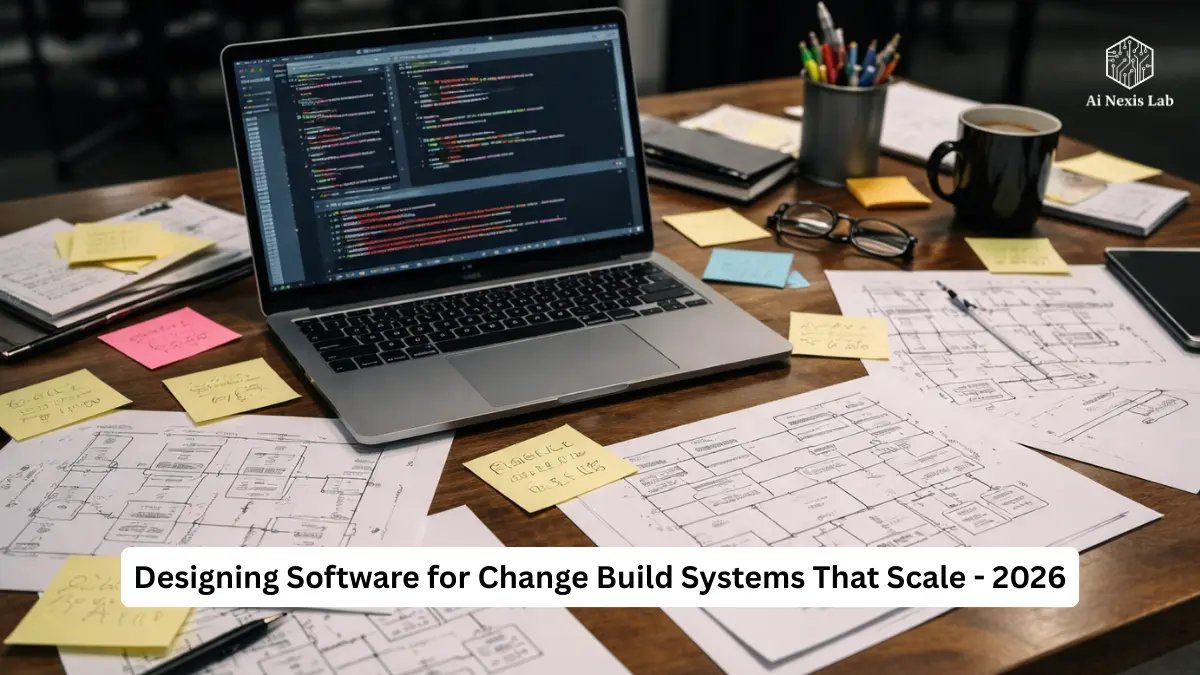
Software design that adapts without costly rewrites. Discover 10 proven architecture tactics to make systems flexible, maintainable, and ready for change with clear real-world guidance.
It usually starts with something harmless.
The product manager asks for “one small change.”
A checkbox.
A new filter.
A different pricing rule.
You open the codebase and immediately feel your blood pressure rise. That checkbox touches:
- Database migration
- Backend service
- A caching layer
- A validation scheme
- A frontend form
- Three test suites
- A slack thread that will never die
You are not adding a checkbox.
You are negotiating with an unstable political system made of code.
Then someone says:
“We should rewrite this.”
Every senior engineer in the room knows what that means:
We failed to design for change.
Not because we are bad engineers.
Because most software is built under pressure, with incomplete information, and leadership that confuses momentum with direction.
This article is about creating systems that don’t require religious sacrifices as a business evolves. Not “future-proofing everything”. Just engineering with the assumption that change is guaranteed.
Because in 2026, the only constant is:
Your needs will change.
1. Rewrites aren’t a technology problem. They’re a systems thinking problem.
Let’s get this out of the way:
Most rewrites fail.
Multiple industry surveys from 2023–2025 (McKinsey, ThoughtWorks Tech Radar, and GitHub Enterprise Reports) show similar patterns:
- Full rewrites take 2–3x longer than average estimates
- Deliver 30–60% fewer features than promised
- Introduce new defect clusters that don’t exist in legacy systems
- Often abandoned mid-way
The code wasn’t the real problem.
The architectural boundaries were lacking.
When a system becomes difficult to change, engineers blame:
- The architecture
- The language
- The database
- The backend team
But the real root cause is almost always:
Uncontrolled connectivity.
When everything knows everything, any change becomes a structural operation. That’s when organizations start fantasizing about “greenfield rewrites” – because it seems emotionally easier than messing with reality.
The tragedy?
Most rewrites reintroduce the same connection, just with new syntax.

2. What actually changes in real software design systems
If you want to design for change, you need to understand what actually changes in real products.
Not theory. Reality.
Static areas (change slowly)
- Core business rules
- Domain definitions
- Basic data models
- Financial or compliance logic
- Invariants (“user must have a verified identity”)
These evolve, but slowly and with careful negotiation.
Volatile Areas (Constantly Changing)
- UI/UX Patterns
- Third-Party Integrations
- Payment Providers
- Analytics Tooling
- AI Model Providers
- Marketing Experiments
- Infrastructure Vendors
- Feature Flags
- A/B Testing Logic
In 2026, volatility is even higher because:
- AI services frequently roll out APIs and pricing models
- Cloud providers constantly roll out new primitives
- Production teams run experiments weekly
- Rules are updated quarterly (privacy, payments, AI governance)
If your stable core relies directly on unstable edges, you’ve already lost.
That’s the architectural sin that leads to rewrites.
3. Two Silent Killers: Rigidity and Fragility
These two destroy long-lasting systems.
Rigidity
Change in one place requires change everywhere.
Example:
Adding a new price tier requires editing:
- Database Enum
- Backend Validation
- Frontend Forms
- Billing Service
- Analytics Pipeline
- Email Templates
That’s rigor.
Fragility
A change in one place breaks unrelated behavior.
Example:
Updating the user profile schema breaks login sessions, notification settings, and referral tracking.
That is fragility.
Both come from the same root:
Unclear or non-existent boundaries.
When boundaries are blurred, teams start sharing databases, internals, SDK calls, or global state. Every shortcut seems efficient – until six months later.
4. Why “modern stacks” won’t save you
A harsh truth:
Switching from React to Svelte won’t fix bad boundaries.
Moving to microservices won’t fix bad domain modeling.
Adding Kubernetes won’t fix tight coupling.
In fact, modern stacks exacerbate bad architecture.
A monolith with weak boundaries is painful.
A distributed system with weak boundaries is destructive.
In 2024-2026, we saw countless startups prematurely move to microservices, only to find:
- Network spaghetti instead of code spaghetti
- Latency chaos
- Versioning hell
- Orchestration complexity
- Teams blocked on API changes
They didn’t need microservices.
They needed a modular design.
5. The only architecture that scales: clear boundaries
Think of your systems as neighbors, not rooms in the same house.
Each neighbor:
- Holds its own data
- Has its own rules
- Exposes only the necessary interfaces
- Does not access the internals of the other
In practical terms:
Does not query the inventory shipping database.
Billing does not manipulate the user’s internal tables.
The frontend does not embed SQL queries (yes, this still happens).
Communication is done through:
- API
- Events
- Message queues
- Contracts
When boundaries are clean:
- Teams work independently
- Changes remain local
- Testing becomes easier
- Scaling becomes easier
- Rewrites become unnecessary
6. Dependency Inversion Reality Check
Classic principle. Often misunderstood. Rarely applied correctly.
Most systems still look like this:
UI → Services → DatabaseWhich means:
- Business logic depends on database details
- Changing storage breaks logic
- Requires real infrastructure for testing
Proper dependency inversion reverses this:
UI → Business Logic → Interfaces ← Infrastructure implements themNow:
- Business logic defines what it needs
- Infrastructure adapts to business needs
- Logic can be changed without rewriting the storage engine
- Tests run without a database
This is not academic purity. This is why companies like Stripe, Shopify, and Netflix can swap internal data platforms without rewriting product logic.
7. Encapsulation: Hiding the mess where it matters
Encapsulation is not about getters and setters.
It’s about containing change.
The module should hide:
- What database does it use
- What vendor SDK does it wrap
- What caching strategy does it implement
- What AI model provider does it call
Customers shouldn’t worry.
If your “payment service” directly exposes Stripe objects, you have leaked Stripe to your entire system. When Stripe changes their SDK (which they do frequently), half of your code breaks.
The solution to this problem is simple:
- Wrap up third-party libraries
- Expose your own interfaces
- Treat vendors as interchangeable parts
Yes, it adds a small layer.
No, it’s not wasted effort.
It’s insurance.
8. The Open/Closed Principle in the Real World
Bad Example:
if (user.type === 'free') ...
else if (user.type === 'pro') ...
else if (user.type === 'enterprise') ...
Every new tier edits existing code.
Good example:
interface UserTier {
   calculateLimits()
}
New layer = new class.
Existing logic untouched.
This is important because in real businesses:
Price levels change
Feature entitlements change
Regional compliance differs
If each change modifies the core logic, risk accumulates. If every change adds a new module, the risk remains contained.
9. Status: The Hidden Source of Rewrite Pressure
Globally variable status is a silent killer.
When state:
- Lives in multiple caches
- Shared across services
- Has side effects
- Updates in hidden places
Every change becomes scary.
Modern resilient systems include:
- One-way data flow
- Event-driven updates
- Explicit side effects
- Immortal performance
This is why architectures such as:
- CQRS
- Event sourcing
- Functional cores with essential shells
are increasingly common in critical 2026 systems – especially where auditability and AI decision pipelines are critical.
Because they’re trendy.
Not because they’re trendy.
Because they change.
10. APIs are contracts. Treat them like legal documents.
Internal APIs are treated as incidental. Big mistake.
In mature organizations:
- Every API is versioned ad hoc
- Breaking changes require migration windows
- Schemas are validated
- Backward compatibility is tracked
Because once multiple teams or services rely on an interface:
Your API is no longer code. It’s a promise.
Promises break randomly and teams stop trusting each other. That’s when momentum breaks.
11. The Strangler Pattern: How Real Rewrites Actually Work
The only rewrite strategy that consistently works in production:
Replace in slices.
Step-by-step:
- Identify a subsystem
- Create a new version alongside the old
- Rout a small percentage of traffic
- Monitor metrics
- Expand gradually
- Remove the old component
No downtime.
No “big bang”.
No business disruption.
Like this:
- Netflix replaced its monolith
- Amazon decommissioned internal services
- Shopify modernizes core checkout
- Big banks modernize COBOL backends
Heroes don’t rewrite.
Controlled evolution.
12. Modern 2026 Reality: AI Integration Increases Need for Clean Boundaries
New Factor in 2026:
AI Services Are Unstable Dependencies.
Model pricing changes.
API updates.
Latency fluctuates.
Data governance requirements change.
If your business logic directly calls OpenAI/Anthropic/Gemini, you are embedding instability at the core.
Mature systems:
- Wrap AI calls behind internal prediction interfaces
- Cache model output where appropriate
- Allow multi-provider routing
- Implement fallback strategies
Because LLM providers evolve monthly. Your business logic shouldn’t have to be rewritten monthly.
13. The Brutal Truth About “We’ll Fix It Later”
Later never comes.
Interest on technical debt accrues faster than financial debt.
Every new feature added on an unstable foundation increases the likelihood of a rewrite.
But here’s an uncomfortable leadership truth:
Most rewrites are management failures, not engineering failures.
It results from:
- Shipping without an architectural runway
- Ignoring refactoring windows
- Measuring only short-term velocity
- Treating engineers as feature factories
Requires time allocation to design for change.
No time allocation → no change tolerance → rewrite crisis.
14. A Practical Checklist for Change-Ready Systems
Ask these questions:
- Can I swap out the database without touching the business logic?
- Can I swap payment providers without rewriting the checkout?
- Can I test the core logic without the infrastructure running?
- Does each module have its own data?
- Are third-party SDKs wrapped?
- Is the API versioned?
- Is global mutable state minimal?
- Do I know exactly where the side effects occur?
If most of the answers are “no,” you’re starting to rewrite.
15. How much does “design for change” really cost
Upfront costs:
- A little more interface
- A little more abstraction
- A little more planning
- A little slower initial feature delivery
Long-term payoff:
- Faster feature iteration
- Lower regression risk
- Easy onboarding
- Easy vendor changes
- No existential rewrite projects
This is not idealism. It is standard practice in high-performing engineering organizations.
16. Common myths that still waste teams’ time
Myth: Microservices solve rewrites.
Reality: Microservices multiply boundary problems if the boundaries are wrong.
Myth: Rewrites = clean slate.
Reality: New systems inherit the same organizational flaws.
Myth: Premature abstraction is always bad.
Reality: The lack of abstraction is worse in volatile domains.
Myth: Future-proof everything.
Reality: Create for expected change, not for an imaginary future.
17. A mindset shift that actually works
Stop thinking in terms of:
Start thinking in terms of:
Change the control strategy.
Every design decision should answer:
“When this inevitably changes, where does the change reside?”
If the answer is “everywhere,” you’ve rewritten.
18. The Ultimate Reality Check
If your system:
- Requires hero refactors for simple changes
- Has mysterious side effects
- Has shared databases across domains
- Vendor SDK leaks everywhere
You don’t need new technology.
You need boundaries.
If your system:
- Incorporates volatility
- Exposes static interfaces
- Keeps business logic pure
- Treats infrastructure as pluggable
You won’t need to rewrite.
You’ll be constantly evolving.
This is the difference between software that ages like milk and software that ages like wine.
Frequently Asked Questions
Q: Is this only for large-scale systems?
A: No. Small startups need this more because they change more frequently. Bad boundaries kill startups faster than big companies.
Q: Isn’t this just overengineering?
A: It only becomes overengineering if you create abstractions for hypothetical needs. Designing clear boundaries for known instability is not overengineering – it’s about survival.
Q: Should we always avoid rewriting?
A: A complete rewrite is only justified when:
1) The domain model was fundamentally wrong
2) A ground-up rebuild is required for compliance
3) The old system cannot meet non-functional requirements (security, latency, regulation)
However, use a strangler strategy.
Q: Are microservices necessary?
A: No. A well-designed modular monolith beats a poorly designed microservice system every time.
Q: How do we begin to fix the current mess?
A: Start with:
1) Identifying domain boundaries
2) Wrapping external dependencies
3) Extracting business logic from infrastructure
4) Writing characterization tests
5) Implementing the strangler pattern sequentially
No big bang.
Q: What is the biggest mistake teams make?
A: Letting business logic rely on infrastructure details. That’s a mistake most rewrite cycles make.
Q: Do modern frameworks like Next.js, NestJS, or Spring Boot solve this problem?
A: They help with the structure. They don’t impose boundaries. The architecture is still your responsibility.
Q: How does AI affect this?
A: AI integration changes faster than almost any other dependency. Treat AI providers as unstable frameworks. Never let AI SDKs enter the core logic.
Q: What is the quickest sign that a system is moving towards rewriting a region?
A: While engineers hesitate before making simple changes, fear is an architectural criterion.
Q: What is the ultimate goal?
A: Not to avoid change.
To make change boring.
Final Thought
Software that survives is not written by talented coders.
It is built by teams that respect boundaries, expect volatility, and refuse to mortgage the future for short-term momentum.
Design for change – or change will design your next rewrite for you.