
The Great Framework Migration: Next.js vs SvelteKit vs Astro – Who Really Offers Sub-100ms Performance?

Introduction: Why Milliseconds Suddenly Matter
Comparing Next.js vs SvelteKit vs Astro for real-world sub-100ms performance, core web vitals, hydration costs, and interactive times to find the fastest framework.
Something fundamental has changed on the modern web.
Not long ago, most of us were satisfied with “fast” page loading. A spinner here, a little delay there – it was an accepted cost of creating rich, JavaScript-heavy experiences. Single page applications became the default, and we learned to live with the side effects: bloated bundles, delayed interactivity, and that awkward moment when the page appears ready but doesn’t respond.
Today, that tolerance is gone.
Search engines, especially Google, are taking a tough stance on core web vitals. Users are impatient. And the data has made one thing painfully clear: even a 100-millisecond delay can quietly destroy conversions, engagement, and trust.
That pressure has started what many developers are now experiencing – a great framework migration. Teams are rethinking long-held assumptions and asking a sharp question:
What framework not only looks fast in demos, but can reliably deliver a sub-100ms experience in the real world?
At the heart of this debate are three very different philosophies:
- Next.js, the dominant React framework, is being aggressively developed with server components and edge rendering
- SvelteKit, built on a compiler that removes runtime overhead before it reaches the browser
- Astro, which takes the most radical position: avoid shipping JavaScript unless absolutely necessary
This is not a comparison of features. It is an architecture. When performance is non-negotiable and milliseconds equal money, which approach really survives?
Let’s break it down – quietly, honestly, and without propaganda.
Part 1: What “Sub-100ms Performance” Really Means
Before comparing frameworks, we need to clear up a common misconception.
When people say “sub-100ms performance,” they are usually mixing two very different measurements together.
1. Time to First Byte (TTFB): Server Speed
TTFB measures how long it takes for the first byte of a response to arrive after a user makes a request.
Today TTFB below 100ms is very achievable – and it often has less to do with the framework than people think. It largely depends on:
- Hosting on a global edge network
- Effective caching
- Fast data access (or no blocking data calls at all)
All three frameworks – Next.js, SvelteKit, and Astro – can hit this target in the right situations.
But here’s the catch.
2. Time to Interactive (TTI): User Reality
TTI is what users actually experience.
It measures how long it takes for a page to be fully usable – when buttons respond immediately and the browser’s main thread is not blocked by JavaScript execution.
This is where most modern websites fail.
A page can appear complete in 200ms but still take another second to become interactive. That gap – which is caused by JavaScript downloading, parsing, executing, and hydrating – is a real performance killer.
So when we talk about “guaranteeing below 100ms”, we are really talking about reducing or eliminating client-side JavaScript work.
That’s where these frameworks start to diverge sharply.
Part 2: Next.js – The Cost of Power, Scale, and Responsiveness
Next.js is the biggest in this fight.
It powers everything from startups to Fortune 500 platforms. Its ecosystem is vast, its tooling is mature, and its developer experience is polished.
But it also carries historical and architectural baggage.
How Next.js is made today
Modern Next.js revolves around a hybrid model:
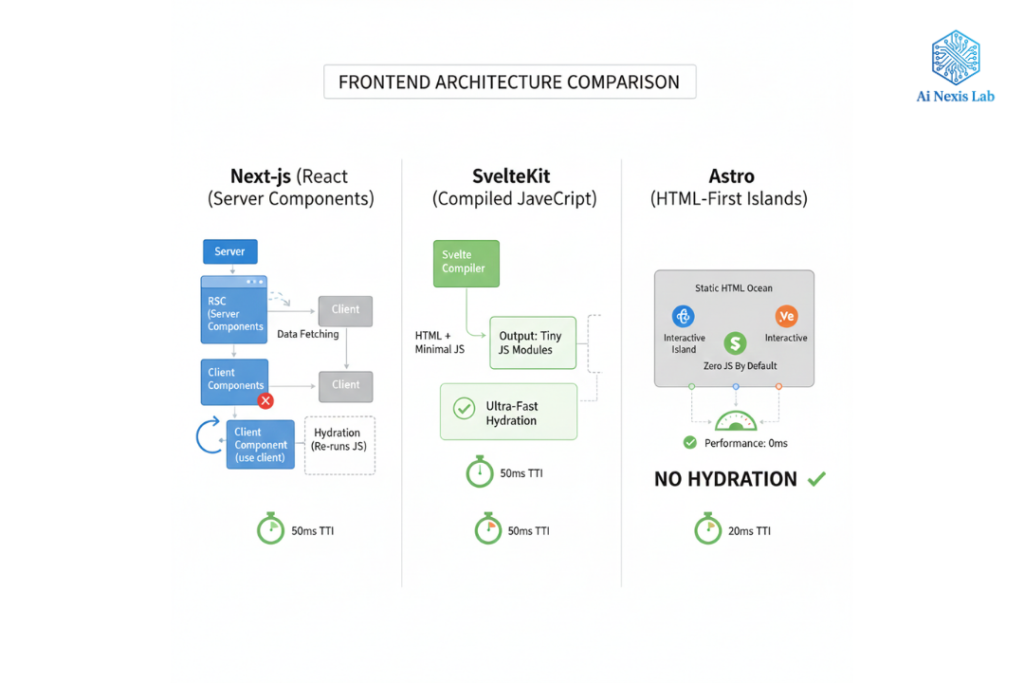
- React Server Components (RSC) handle non-interactive UI on the server
- Client components handle interactivity in the browser
- Server actions reduce the need for separate API layers
- Rendering can happen on Node.js or at the edge
In theory, this is a big leap. Large parts of the UI never reach the browser as JavaScript, which significantly reduces bundle size.
Where performance still falls short
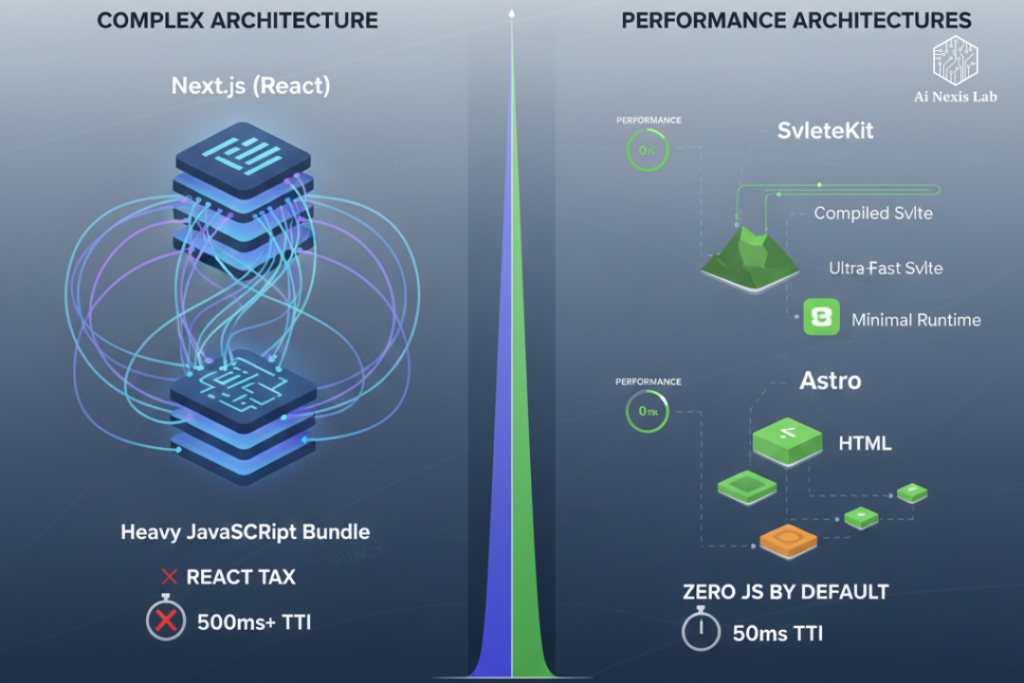
Despite these improvements, Next.js cannot escape one key reality: React itself must run in the browser.
It brings some unavoidable costs:
- The React runtime must be downloaded
- Component trees must be rebuilt during hydration
- Interactive components still block the main thread during startup
Even with selective hydration, each interactive region adds CPU overhead.
On smaller pages, this is manageable. On complex, component-rich pages, the costs increase quickly.
The Verdict on Next.js
Next.js can be quite fast.
But fast in Next.js is something you earn through discipline, not by default. Achieving interactivity below 100ms requires:
- Aggressive component separation
- Minimal client components
- A deep understanding of React server components
- Careful avoidance of unnecessary JavaScript
For large SaaS products, dashboards, and enterprise applications, the trade-off is often worth it.
But as a framework that guarantees performance below 100ms? Next.js is uphill.
Part 3: SvelteKit – When Frameworks Disappear
SvelteKit brings a solution to the problem from a completely different perspective.
Instead of optimizing the runtime, Svelte eliminates the runtime entirely.
The Compiler Advantage
At build time Svelte components are compiled into highly efficient JavaScript that manipulates the DOM directly. There is no virtual DOM. There is no diffing engine. There is no heavyweight abstraction layer.
What reaches the browser is exactly what is needed – and nothing else.
That single decision changes everything.
Why this matters for speed
- JavaScript bundles are dramatically smaller
- Hydration work is minimal and precise
- Browser does less CPU work during startup
As a result, SvelteKit pages often become interactive immediately after parsing the HTML.
This is especially noticeable on low-end devices, where React-based applications struggle the most.
The Trade-Offs
SvelteKit isn’t perfect.
- The ecosystem is smaller than React
- It can be difficult to hire experienced Svelte developers
- Some advanced third-party libraries don’t exist yet
But from a performance perspective, SvelteKit sets a very high bar. You have to work hard to make it slow.
Verdict on SvelteKit
If your goal is to build a real application – not just a static site – but still want near-instant interaction, SvelteKit offers one of the cleanest paths available today.
It does not remove JavaScript. It just refuses to mess with it.
Part 4: Astro – Nuclear Alternative for Demonstration
Astro doesn’t try to optimize JavaScript.
It avoids it.
By default, Astro ships zero client-side JavaScript.
That puts it in a completely different category.
Island Architecture Explained
Astro treats pages as mostly static HTML with small, isolated interactive “islands”.
Each island:
- Loads its JavaScript independently
- Hydrates only when needed
- Can be delayed until visible or inactive
The rest of the page remains untouched, static, and immediately interactive.
No central framework runtime. No global hydration steps. No JS taxes.
Why Astro wins on Raw Performance
For content-heavy pages, Astro’s performance is almost boringly fast:
- TTI is effectively equal to TTFB
- No JavaScript means no blocking execution
- Performance remains stable as pages grow
This is the closest thing to a performance guarantee you can get on the modern web.
Where Astro struggles
Astro is not designed for app-like experiences.
Complex shared state, real-time interactions, and SPA-style navigation are possible – but hard.
Astro shines when most of your content is static and only small parts require interaction.
The Verdict on Astro
For marketing sites, blogs, documentation, and storefronts, Astro is unmatched.
It doesn’t optimize for speed – it eliminates the problem entirely.
Part 5: Comparing Important Architectures
The real difference between these frameworks is not in syntax or tooling. It’s in what they assume by default.
- Next.js assumes interactivity everywhere
- SvelteKit assumes minimal, efficient interactivity
- Astro assumes no interactivity until proven necessary
And is more important than default optimization.
Performance regressions usually don’t happen because developers are careless. It happens because the framework makes it easy to send too much JavaScript.
Astro makes you choose. SvelteKit keeps it engaging. Next.js makes you constantly manage it.
Part 6: The Big Picture – Where the Exhibition is Leading
The industry is slowly realizing that hydration is a real obstacle.
Emerging ideas such as resumability aim to eliminate hydration entirely by allowing the browser to resume a server-rendered state without having to re-execute the code.
Frameworks like Qwik are aggressively exploring this space.
If React ever adopts resumability at scale, it could erase its current performance disadvantage.
Until then, the hierarchy remains clear.
Final Verdict: Choosing the Right Bet
There is no universal winner – just better architectural matches.
Choose Astro if:
- Your site is content-driven
- SEO and core web vitals are important
- You want performance guarantees, not best-case scenarios
Choose SvelteKit if:
- You’re building a modern web app
- You want near-instant interaction by default
- You’re willing to trade ecosystem size for speed
Choose Next.js if:
- You’re building at scale
- You rely heavily on the React ecosystem
- You’re willing to proactively manage performance
The lesson of great framework migrations is simple:
The fastest code is the code you never ship.
Astro proves that elimination beats optimization. SvelteKit proves that compilers matter. Next.js proves that scale comes with a trade-off.
Sub-100ms performance isn’t magic – it’s architecture.
Frequently Asked Questions: Next.js vs. SvelteKit vs. Astro
Q1: Which framework is the fastest overall?
Astro is fastest for content-based sites because it sends little or no JavaScript. For applications, SvelteKit generally provides faster interactivity than Next.js.
Q2: Can Next.js achieve performance below 100ms?
TTFB, yes. Consistently keeping interactive times below 100ms on complex pages is difficult due to React hydration overhead.
Q3: Is Astro good for SEO?
Yes. Astro outputs static HTML by default, making it great for SEO and core web vitals.
Q4: Is SvelteKit ready for production?
Yes. It is stable, actively maintained, and used in production by many teams – but its ecosystem is smaller than React.
Q5: Which framework is best for a SaaS application?
Next.js and SvelteKit are better suited. Astro is not ideal for very stateful, app-like experiences.
Q6: Should I migrate my existing React site to Astro?
For marketing pages or blogs, often yes. For complex applications, a hybrid approach or incremental optimization may be more practical.