
2026: Micron Ends Crucial as AI Chips Spark the Great Memory Shift
Micron Ends Crucial: How AI Sparked the Great Memory War by 2026
Micron is shutting down its Crucial brand and leaving the DIY market to focus on high-bandwidth memory for artificial intelligence. This change has led to what many call the “Great Memory War”, where every major chipmaker is fighting for faster AI training speeds. As Crucial disappears, experts expect RAM and SSD prices to rise, and the entire storage market to reshape itself in real time.
Micron’s Exit from Consumer Memory to Focus on High-Bandwidth Memory
If you’ve ever built a computer from scratch, upgraded your own RAM, or helped a friend speed up their slow laptop, you’ve probably crossed paths with Crucial. For nearly 30 years, Crucial was the brand you recommended when someone asked:
“What RAM should I buy? I don’t want anything fancy. Just something that works.”
Crucial was a stable, common sense option. No neon lights. No dramatic marketing. Just reliable, affordable memory that did exactly what it promised.
And now it’s gone.
Micron, the parent company behind Crucial, has made a decision that has sent shockwaves throughout the PC market:
They are discontinuing the Crucial consumer product line in early 2026 to focus on high-value AI memory.
This is no small change to the product portfolio. This isn’t like “we’re stopping production for a while.” This is the end of a 29-year legacy… because artificial intelligence has changed the economics of memory forever.
This is more than just a business decision.
This is a cultural moment.
The DIY PC community – millions of tinkerers, gamers, and home builders – has lost one of its most trusted brands.
And that raises a big question:
Are consumers now suffering collateral damage in the race to build AI?
Let’s look at what happened, why it happened, and what it means for the rest of us.
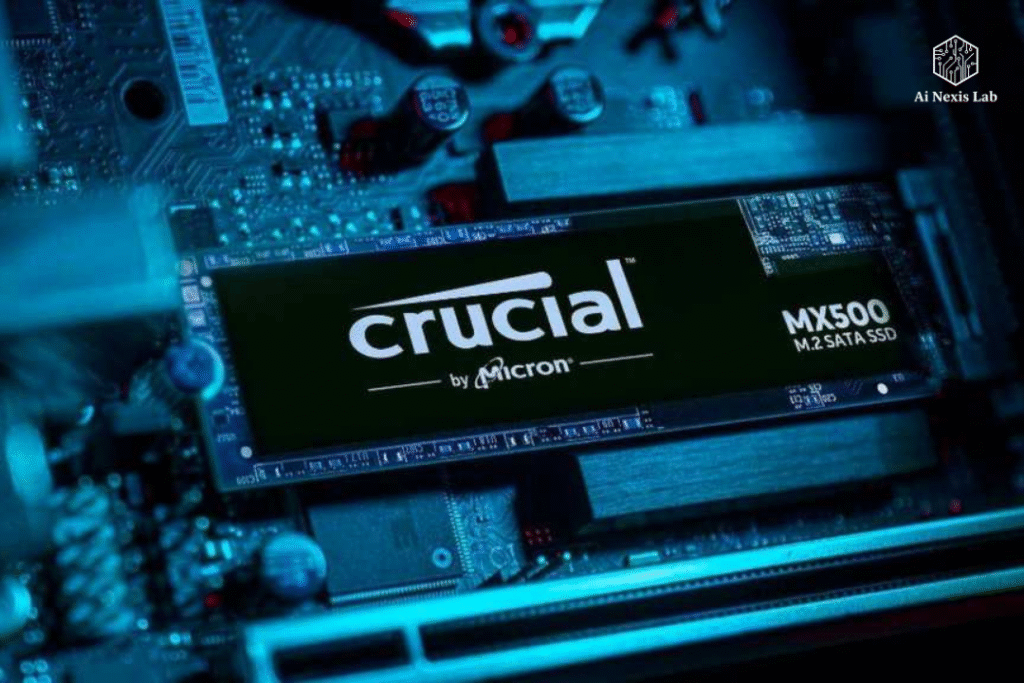
Part 1: A Quiet Funeral for a Beloved Brand
Crucial wasn’t designed to be sexy. It was created to be useful.
His goal was simple:
Take the DRAM and NAND manufactured by Micron for data centers… and package it in a way that everyday people could install themselves.
For decades, Crucial played three roles perfectly:
1. Consistency
You can buy Crucial memory and know it will work.
2. Clarity
Their system scanner tool was legendary. You run it, it scans your PC, and tells you:
- This is your model
- This is your maximum RAM
- Here are the specific modules you need
It was made easy by DIY.
3. Value
Crucial wasn’t always the fastest or the flashiest — but it was the smartest buy.
- Crucial MX and P-series SSDs dominated budget recommendations.
- Ballistics memory was beloved by gamers and overclockers.
- Millions of laptops were revived with cheap Crucial upgrades.
It wasn’t just a product.
It was a cult.
If you built your first PC in the 2000s or 2010s, Crucial was probably your first RAM.
And now, by February 2026, this line will disappear.
Micron will honor the warranty, but the brand that created a generation of PC builders is effectively gone.
For many in the community, it seems like the last local hardware store has closed its doors – taken over not by a competitor, but by its own corporate parent who has decided the neighborhood is no longer worth serving.
Part 2: The Cold Math Behind the Decision
Micron didn’t shut down Crucial because of weakness.
They shut it down because of strength.
From a financial perspective, the consumer memory business is a nightmare:
- Prices are volatile.
- The margins are small.
- The supply cycle is brutal.
- The competition is fierce.
A $69 SSD today could be $49 next month and $89 two months later. Customers wait for sales. Retail partners demand promos. There are returns, warranties, shipping complications.
In short:
Selling to millions of small customers is hard work with small rewards.
Compare that to selling to hyperscalers like:
These companies don’t want an 8GB laptop RAM stick.
They ask:
“You can produce as much high bandwidth memory as possible. Forever.”
And here’s the key difference:
Customer memory = commodity
Small margins. Constant price pressure.
AI Memory = Premium
Huge Margin. Contract volume. Close relationships.
Micron executives stated bluntly:
AI demand is so large, so profitable, and so persistent that supporting consumer retail no longer makes sense.
Micron is essentially reallocating production capacity:
- From $30 RAM sticks
to
- $1,000+ HBM stacks
It’s not sentimental. That’s logical.
Wall Street understood immediately.
PC builders didn’t.
Part 3: Why High Bandwidth Memory Changed Everything
To understand this pivot, you need to understand High Bandwidth Memory (HBM) — the crown jewel of AI computing.
Traditional memory, like the DDR5 in your desktop, sends data horizontally across the motherboard. That’s fast enough for games and apps.
HBM is completely different.
Instead of spreading the memory out… it stacks it vertically.
Imagine taking 8 to 12 memory chips and gluing them on top of each other like a skyscraper. Now drill microscopic tunnels through them — called TSVs — so that data can be transferred vertically.
This stack sits next to the AI chip.
The result?
It becomes much faster.
HBM provides:
- Large bandwidth
- Low latency
- High power efficiency
- Small physical footprint
HBM is the fuel that feeds:
- AI training
- LLM prediction
- Data center acceleration
Without HBM, chips like NVIDIA’s H100 and B200 would be starved for data.
AI is no longer constrained by compute.
AI is constrained by memory bandwidth.
The faster the memory can feed the chip, the faster the AI learns.
That’s why Micron isn’t just moving into HBM.
They’re betting on their company’s future.
Part 4: Consumer Consequences – Higher Prices, Less Choice
Micron’s exit from the consumer market is like removing a pillar from a bridge. The entire structure shakes.
Crucial represents an estimated 20-25% of global retail DRAM volume.
When it disappears:
Prices go up.
Memory prices were already rising due to rising AI demand. Some sectors saw price increases of +170% in a single year.
Now remove a major supplier?
That’s gasoline on the fire.
What happens next:
Fewer brands
Crucial is gone. Others rely on Micron, Samsung, or SK Hynix for chips. Once one supplier is gone, supply becomes tighter.
Higher costs for everyone
Third-party brands like Corsair and Kingston will pay more for base DRAM wafers. They will pass those costs on.
Budget options disappear
Crystal was a champion of affordable upgrades.
Without it?
The market is shifting towards high-margin enthusiast products.
Expect more:
- RGB gaming RAM
- “Extreme” modules
- Premium pricing
And less:
- $49 laptop upgrades
- $59 SSD deals
The DIY builder is no longer a priority customer.
Part 5: The New Oligopoly
Micron’s Exit Creates a New World:
We now have three titans shaping the future of memory:
- Samsung
- SK Hynix
- Micron
All three are racing to make faster HBM.
This is where the next trillion dollars will be made.
Micron’s move forces Samsung and SK Hynix to ask themselves:
Should we continue to sell to customers at low margins, or focus entirely on AI memory at high margins?
If they follow Micron…
The consumer market will shrink further, leaving only:
- Boutique vendors
- Specialty enthusiast suppliers
- High prices
This is the beginning of a new hierarchy:
Tier 1: AI Memory
HBM4, HBM3E, extreme packaging
- high margins, guaranteed demand
Tier 2: Enterprise and data center
SSD and storage for servers
- Stable, high-volume contracts
Tier 3: Consumer products
Desktop RAM, gaming SSDs
- low margins, low priority
The era of consumer-first memory is over.
Conclusion: A bittersweet farewell
Crucial was never glamorous.
It was never the fastest.
It was never the loudest.
But it was ours.
It gave millions of people a gateway into the world of building and upgrading PCs. It empowered home users, small businesses, students, gamers, and hobbyists.
His exit marks the end of a chapter.
The future belongs to stacked silicon designed to feed AI models with unimaginable data.
A million PC builders can’t compete with a single hyperscaler training a trillion-parameter model.
Micron dropped Crucial because Crucial failed.
Micron dropped Crucial because AI won.
And in this new world, the humble ram steak is no longer a hero. The Hero is a vertical tower of memory connected to the world’s most powerful chips.
This is the great memory war.
Crucial was just one casualty.
Frequently Asked Questions: Micron, Crucial, AI Memory, and HBM
Q1: Why did Micron shut down Crucial?
Micron has shut down its consumer brand to redirect production capacity towards High Bandwidth Memory (HBM), which is experiencing explosive demand from AI companies. HBM is dramatically more profitable than consumer DRAM and SSD.
Q2: What is High Bandwidth Memory (HBM)?
HBM is a type of vertically stacked memory that sits next to AI chips and provides extremely high bandwidth. It allows GPUs and accelerators to access data much faster than traditional DDR or GDDR memory.
Q3: Does this affect regular PC upgrades?
Yes. Customers will face:
1) High RAM Prices
2) Low Budget SSD
3) Tight Supply
The market is moving away from entry-level upgrades.
Q4: What will happen to warranty and support?
Micron has stated that they will honor all existing Crucial warranties. Support will continue, but no new retail products will be produced after the start of 2026.
Q5: Will other brands fill this void?
Brands like Samsung, SK Hynix, Corsair, Kingston, and G. Skill will remain unchanged – but they will all face limited chip supplies. They may prioritize high-margin gaming products over affordable upgrades.
Q6: Is this the end of DIY PC building?
No — the community will continue. But it will become more expensive. The “budget build” era is fading.
Q7: Is Micron the only company focusing on AI memory?
No. All three major memory manufacturers are racing to dominate HBM:
1) Samsung
2) SK Hynix
3) Micron
Micron has taken the most dramatic step by completely abandoning consumer retail.
Q8: Will HBM come to gaming PCs?
Eventually, yes – but not anytime soon. Current HBM demand is absorbed by:
1) Data centers
2) AI training clusters
3) Enterprise accelerators
Gamers are far down the priority chain.
Q9: What is the timeline for Crucial’s shutdown?
Micron stated the consumer business will be phased out by the end of its fiscal Q2 2026.
Q10: How does this impact the long-term future of memory?
We are entering an era defined by:
1) Vertical Stacking
2) Packaging Innovation
3) Power Efficiency
4) Bandwidth
Traditional consumer RAM is no longer the focus of the industry – AI memory is.