Compound Interest: 5 Proven Ways to Make Your Money Work Harder
A Related Guide to Compound Interest: How to Make Your Money Work Harder Than You Think
Introduction: The Real Wealth Cheat Code
Compound interest explained like never before! Discover how small investments turn into big assets with time, consistency, and smart strategy.
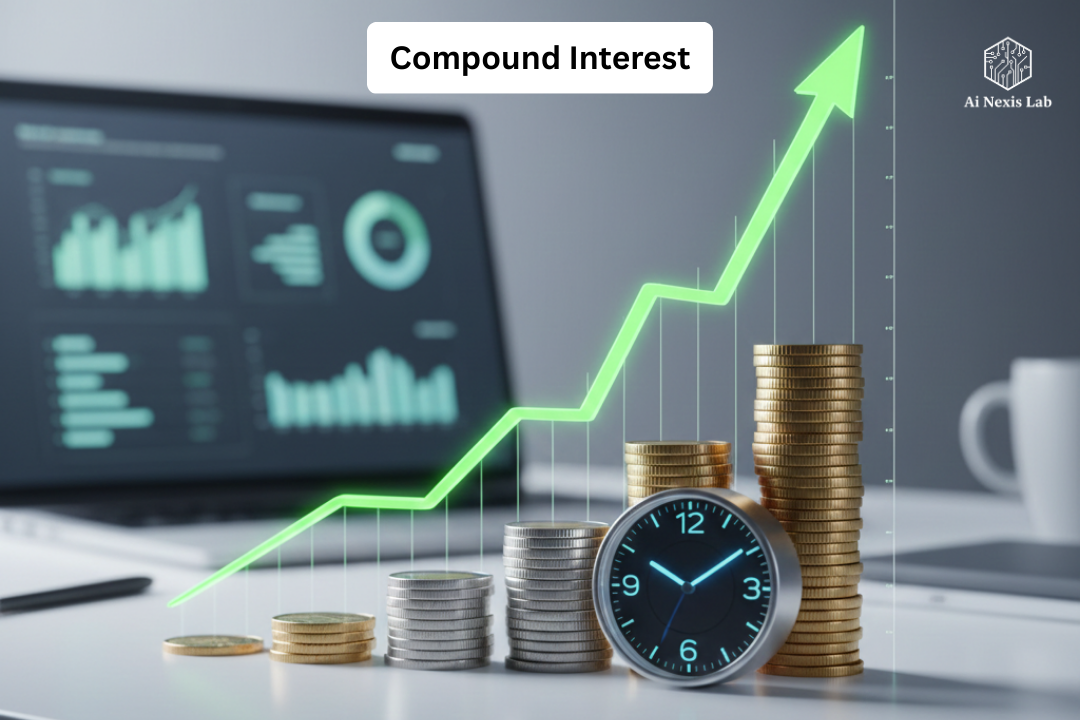
If a budget is the roadmap to your financial future, compound interest is the engine behind it.
That’s what transforms slow savings into snowballing growth.
Most of us have heard of compound interest at some point. We may remember some vague explanation from school, or perhaps we’ve heard financial experts say its name as if it were some mysterious magic.
But here’s the real truth:
Compound interest is the secret ingredient behind generational wealth – and anyone can use it.
You don’t have to be rich, highly educated, or financially savvy.
All you need is time and consistency.
To get the picture, imagine pushing a small snowball down a hill. At first, it barely grows. It’s slow. Boring. Pointless.
But as gravity kicks in and the ice starts to stick, the ball grows faster… and faster… until it becomes a massive, unstoppable force.
That snowball is your money.
Snow is compound interest.
Once compounding starts working for you, the growth becomes so powerful that it can eventually earn you more in a year than you’ve earned in an entire decade.
This is the magic we are going to break – in plain language, with real-life examples and no confusing formulas.
1. What is compound interest?
To understand compound interest, we first need to compare it to something simpler.
Simple Interest vs. Compound Interest: A Simple Analysis
Simple interest only pays you on what you originally put in.
Compound interest pays you on what you put in and what it has already earned.
This means that you earn interest on interest.
Simple Example
Let’s say you invest $1,000 at 5%:
Simple interest = $50 per year forever.
Compound interest = $50 the first year, then $52.50 the second year, then $55.13… and it keeps going up.
The formula doesn’t matter.
The result is questionable.
Compound interest is the children of your money making… and those children make children.
It is exponential growth, not linear growth.
This is why Einstein famously said it:
“The eighth wonder of the world.”
And he wasn’t kidding.
2. Compound interest has two sides: friend and foe.
Compound interest is not emotional.
It doesn’t matter who you are.
It works for you or against you depending on how you use it.
Friend: Building wealth
When you invest or save in the right places, compound interest becomes your loyal companion.
Take this example:
You invest $10,000 at 7% for 20 years.
| Scenario | Year 1 | Year 10 | Year 20 |
|---|---|---|---|
| Simple Interest | $10,700 | $17,000 | $24,000 |
| Compound Interest | $10,700 | $19,671 | $38,697 |
The initial amount only.
Same rate.
The result is different.
Compound interest gives you an extra $14,697 — for doing nothing but letting time pass.
The Foe: High-Interest Debt
Here’s where compounding becomes a financial nightmare:
- Credit Card
- Payday Loan
- High Interest Personal Loan
Let’s say you owe $5,000 at 20%.
You’re not just paying interest on the $5,000…
You’re also paying interest on last month’s interest.
This is how a small debt can lead to financial difficulties.
Rule:
Kill the high-interest debt first.
Then let compound interest work for you.
3. The Four Pillars of Compounding Power
You don’t need a PhD in finance to get rich.
You only need four components:
- Time
- Rate of return
- Frequency of combination
- Consistency
Let’s break each one down.
Pillar 1: Time — Non-negotiable
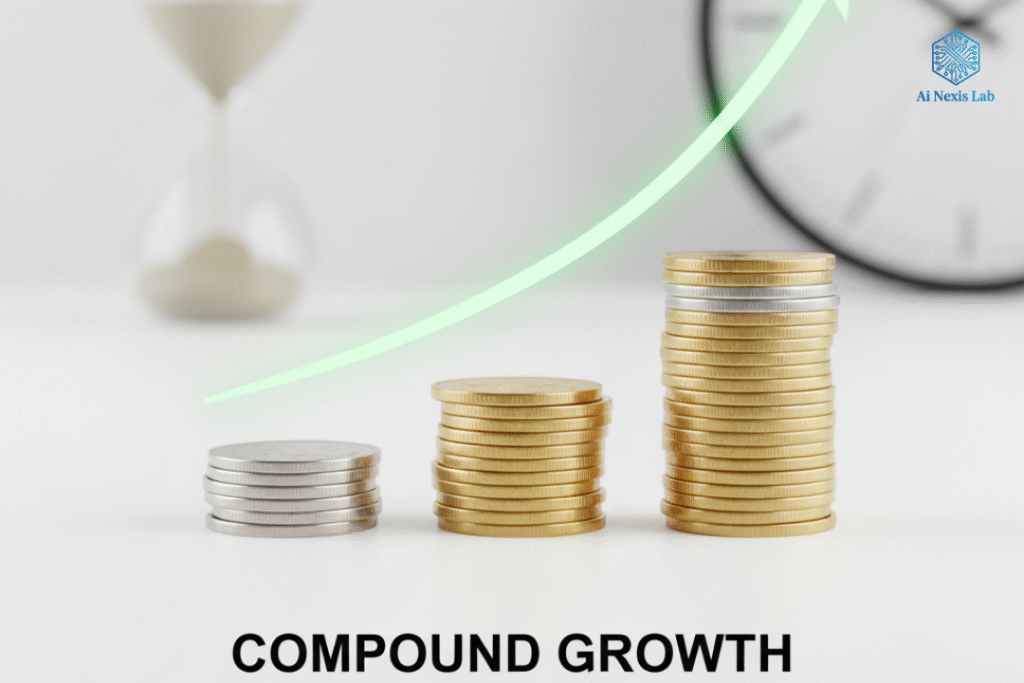
Time is the most powerful element of compounding.
Start early, even with small amounts, and you will win.
The Early Bird vs. The Late Bloomer
Both earn 8% and retire at age 65.
| Investor | Started | Contributed | Years | Total Contribution | Total at 65 |
|---|---|---|---|---|---|
| A | Age 25 | $5,000/year for 10 years | 30 years compounding | $50,000 | $909,394 |
| B | Age 35 | $5,000/year for 30 years | 30 years compounding | $150,000 | $611,720 |
A invested $100,000 less…
but ended up with $300,000 more.
Why?
Her money had an extra decade to grow.
Biggest financial mistake people make? mistake people make?
Waiting to start.
Pillar 2: Rate of Return — Where you put it matters
The savings account will increase by 0.5%.
Just very slowly.
Investing in index funds that give 7-10% returns?
That’s what compounding is all about.
Quick Math Tool: Rule of 72
- Divide 72 by your rate of return.
- This is how many years it takes for your money to double.
Example:
- 72 ÷ 8 = 9 years
Pillar 3: Frequency — How often does interest compound?
More frequent = more growth.
- Daily Compounding
- Monthly Compounding
- Annual Compounding
Even a small difference in 30 years is significant.
Whenever possible:
Choose investments that compound more often.
Pillar 4: Consistency — Small but regular beats large but rare
This is called dollar-cost averaging (DCA):
- Invest a fixed amount each month
- No matter what the market is doing
When prices are high, you buy fewer shares.
When prices are low, you buy more.
It takes the sting out of investing.
You don’t have to time the market.
Just be in the market.
4. Practical Strategies for Using Compounding Right Now
Theory without action is useless.
Here’s how compounding works in real life.
Strategy 1: Automate everything
Set up automatic transfers the day you get paid:
- Move money from checking → investments
- Investments are purchased automatically
You avoid temptation because…
You can’t spend what you can’t see.
This is how ordinary people create extraordinary wealth.
Strategy 2: Reinvest Dividends
Many investments pay dividends.
You can:
- Take the cash, or
- Reinvest automatically
Always reinvest.
Every dividend buys more shares.
Those shares earn more dividends.
Dividends are compounding on steroids.
Strategy 3: Attack High-Interest Debt – Avalanche
List all debts by highest to lowest interest rate.
- Make the minimum payment on everything
- Put every extra dollar toward the highest interest debt
Why it works:
You stop the enemy of compounding first.
Strategy 4: Use tax-advantaged accounts
Avoid losing money in taxes.
Use accounts like these:
- 401(k) / Traditional IRA → Tax-deferred growth
- Roth IRA → Tax-free growth forever
Tax savings = more compounding.
5. The Hockey Stick Curve: Where Most People Give Up
Here’s the emotional truth:
Compounding feels slow in the beginning.
Years 1-15:
You are adding most of the money. The growth seems small.
Years 15-25:
Your investments start contributing more than you do.
Years 25+:
Growth explodes.
This is the “hockey stick curve”:
- Long, flat handle…
- Sudden, wide upward blade
Most people give up during the flat years.
Don’t quit. That’s when compounding is power loading.
Conclusion: Make your money work for you
Now you know the one thing that separates average financial results from extraordinary ones.
Compound interest.
It’s not magic.
It’s math.
And it works as long as you:
- Start now – even $50 a month counts
- Be consistent – automate your contributions
- Leave it alone – let time do the heavy lifting
The day you start investing, you stop working alone.
You will hire an invisible employee who works 24/7 – your money.
He never sleeps.
He never takes a day off.
He never asks for a raise.
He just keeps multiplying.
That’s financial freedom.
Start today.
Frequently Asked Questions (FAQ):
Q1: What is compound interest in simple words?
Compound interest is earning interest on your interest. Your money keeps growing automatically because every year you earn returns on both your principal and the returns you’ve already earned.
Q2: Why is compound interest so powerful?
Because the growth is exponential, not linear. The longer your money stays invested, the faster it grows. After a certain point, compounding starts making more money than you contribute yourself.
Q3: How much do I need to start investing?
Not much. Even $50–$100 per month can grow into hundreds of thousands over time through compounding. The key is consistency, not the amount.
Q4: What’s better: simple interest or compound interest?
Compound interest is almost always better for building wealth. Simple interest only pays on your original deposit, while compound interest pays on your entire growing balance.
Q5: Where should I put my money to get compound interest?
Some popular places are:
1) High-yield savings accounts (for emergencies)
2) Retirement accounts (401k, Roth IRA)
3) Low-cost index funds
4) Dividend-paying stocks
Choose based on your goals and time horizon.
Q6: Can compound interest work against me?
Yes. Credit card debt and payday loans use compound interest against you. If you only pay the minimum interest, your balance can grow quickly. Always pay off the highest-interest debt first.
Q7: How long does compound interest take to work?
It usually takes years to see major results. The first decade seems slow, but later growth accelerates dramatically. Think of it like a hockey stick curve.
Q8: What is the rule of 72?
It’s a shortcut to estimate how long it takes to double your money:
72 ÷ interest rate = years to double
Example:
72 ÷ 8% = 9 years
Q9: What is Dollar-Cost Averaging (DCA)?
DCA means investing the same amount every month, no matter what the market is doing. It avoids emotional decisions and ensures consistency, which is essential for compound growth.
Q10: What is the biggest mistake people make with compound interest?
Waiting to start.
Time is the most important ingredient.
The best time to start was 10 years ago.
The second best time is today.