The Death of the Stock Audio Struggle
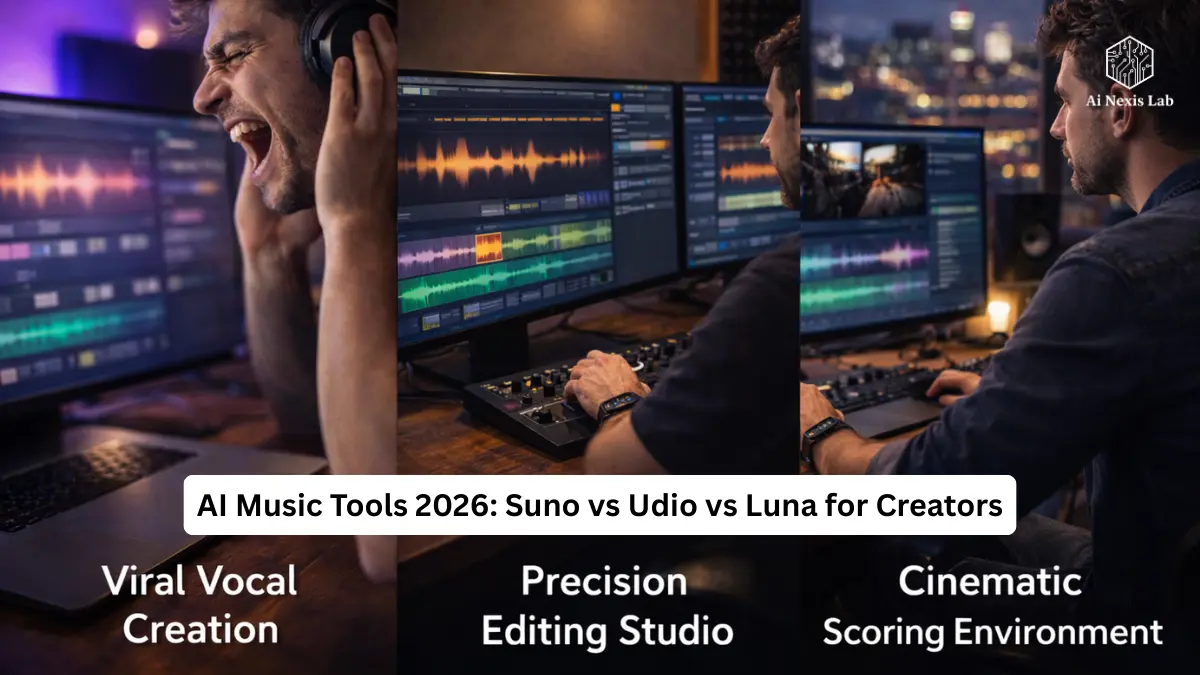
Discover AI music generator tricks for 2026 success with Suno, Udio, and Luna. Proven tips for building viral tracks, increasing workflow, and completing more projects faster.
Table of Contents
Why Suno, Udio, and Luna Music Are the New Creative Standards in 2026
For over a decade, creators have endured something that has quietly slowed them down: the stock music grind.
You spend hours scripting and editing tight videos, polishing transitions, dialing in color grading – only to get stuck on the final step. The music. That endless scroll through “Corporate Inspiration.” That painfully upbeat ukulele loop. That generic cinematic swell that somehow seems the same in every explainer video on YouTube.
It wasn’t just annoying. It was a creative choking point.
Then something changed.
In the last two years, AI music platforms stopped being novelty toys and started becoming legitimate collaborators. Not background generators. Not gimmicks. Real tools capable of producing radio-quality, structurally coherent, emotionally tuned tracks on demand.
If you’ve tested the current generation – especially in 2026 – you already know this isn’t hype.
This is a workflow transformation.
In this in-depth study, we’re going beyond the surface-level buzz and breaking down how Suno, Udio, and Luna Music actually fit into the real creator’s process. Where they shine. Where they still fall short. And what makes sense to you depends on what you’re building.
No nonsense. Just practical reality.
The Stock Audio Bottleneck Was Never About Price
Let’s be clear: stock libraries didn’t fail because they were expensive.
They didn’t fail because they were stable.
You weren’t making music. You were choosing from a fixed menu.
You needed:
- 92 BPM instead of 100
- A softer intro
- No guitar in the second verse
- Exactly the cut at 0:48
Too bad.
You adapted your project to the track instead of having the track shape your project.
AI music reverses that relationship.
You are no longer browsing. You direct.
1. Suno v5 – The Viral Full-Song Machine
What Suno Really Does Well
Suno’s strength is simple: it creates full songs that sound complete.
No sketches.
No loops.
No background bass.
Full songs.
As of v5 in 2026, Suno generates at 44.1 kHz with significantly improved vocal texture compared to the initial release in 2024. The robotic edge that the AI used to remove vocals has been significantly reduced. You still hear artifacts sometimes – but they are no longer “AI clear”.
Suno understands:
- Verse/Chorus dynamics
- Hook placement
- Emotional lift in the final chorus
- Bridge tension
It’s not trivial. Song structure is tricky.
Suno handles it well.
The Advantage of The “Magic Button”
The Suno is designed for speed.
You provide:
- Style
- Mood
- Tempo
- Lyrics (optional)
It gives you two variations in less than a minute.
If you’re creating content on a tight deadline – YouTube shorts, TikTok promos, ad spots – then speed is more important than meticulous perfection.
This is why Suno dominates viral AI songs on social platforms in 2026.
Not because it’s the most technologically advanced.
Because it’s the fastest way from idea to audio.
Custom Mode Is Where It Gets Serious
This is where most people mess up:
They let the AI write everything.
It’s lazy – and it shows.
If you want control, use:
Custom Mode + Metatags
Example:
[Genre: 90s Indie Rock]
[Tempo: 135 BPM]
[Build-up]
[Heavy Guitar Entry]
[Whispered Bridge]
Metatags are not embellishments. They guide the structure.
If you want dramatic compositions or dynamic contrast, you have to say so.
Otherwise you get safe, middle-of-the-road music.
Where Suno Still Falls Short
Let’s not say he’s flawless.
- Limited surgical control
You can’t take 8 seconds apart and just rework that part. - Occasional vocal hallucinations
Extra accents. Slight mispronunciations. - The mix of styles can be confusing.
Ask for too many styles and it gets confusing.
Suno is strongest when you are decisive.
Choose an impressive style. Add texture through adjectives. No mashups.

2. Udio – The Creator’s Tool
If Suno is fast and impressive, Udio certainly is.
Udio feels like it was designed by people who understand manufacturing.
That makes sense – its founding team includes former audio and AI researchers from major streaming platforms.
You feel the difference immediately.
Audio Inpainting: The Game Changer
This is the killer feature of Udio.
You generate a track.
It is 95% perfect.
The singing slows down a bit in the second verse.
Instead of reproducing everything, you highlight that specific section and rewrite it.
It is a product-level control.
Suno doesn’t do this from the same depth.
For serious creators, this is the difference between innovation and a tool.
Why Does The Udio Sound “Bigger”
The stereo imaging of the Udio is stronger.
The instrument placement seems intentional.
There is space in the mix.
It feels less constricting.
If you create YouTube videos with voiceover, the YouTube instrumentals sit more naturally under the narration than most AI tracks.
That’s important.
Background music should support – not compete.
Extension Workflow
If you want quality from your video, don’t generate a full song right away.
Start small:
- Generate 30-32 seconds.
- Extend forward for introduction.
- Extend backward for the bridge.
- Repeat until it feels consistent.
This modular building method gives you tighter results.
It takes longer than Suno – but it’s cleaner.
Where Udio Struggles
- High learning curve
- Credit-based model can be expensive
- Less “instant hit” energy than Suno
It rewards patience.
If you want one-click viral hooks, Suno is fast.
If you want pure control, Udio wins.
3. Luna Music – The Cinematic Specialist
Luna Music does not compete directly with Suno or Udio in pop song creation.
It dominates a different category:
Long-form narrative scoring.
Podcasts.
Documentaries.
Game soundtracks.
Ambient bed.
The Voice-Clear Algorithm
AI music often overfills the midrange – the specific frequency area where human speech sits.
Luna actively carves out that space.
That means:
- Clear voiceover
- Less EQ fixing
- Faster editing
For creators who create long-form content, it’s huge.
Dynamic Prompting for Game Developers
Luna’s keyframe system allows for dynamic evolution.
You can set:
- 0:00–1:00: Calm
- 1:00–2:00: Increasing tension
- 2:00–3:00: Threat level introduced
It’s useful for:
- Indie games
- Immersive apps
- Meditation experiences
- Documentary builds
It’s not attractive.
It is functional.
Limitations
- Low viral song potential
- Subscription-heavy price
- Not built for pop hooks
But if your priority is atmosphere – not the spotlight – then Luna is strong.
Legal Reality in 2026
This is where people get careless.
U.S. The Copyright Office has been consistent: works entirely AI-generated without human authorship cannot be fully copyrighted.
Platforms like Suno and Udio offer commercial usage rights.
It’s not the same as traditional copyright ownership.
If you want defensive ownership:
You need meaningful human input.
That means:
- Writing your own songs
- Providing melody seeds
- Manually editing stems
- Adding live instrumentation
A human-performed element also strengthens your claim.
It is dangerous to ignore this.
Advanced Prompting – Stop Being Vague
“Happy Pop Song” is lazy.
If your output is normal, your input is probably lazy too.
Here is a strong prompt structure:
[Genre: Dark Synthwave]
[BPM: 110]
[Instrumentation: Analog Moog Bass, 808 Drums]
[Atmosphere: Rainy, Neon-lit City]
[Structure: 30-second atmospheric intro, drop at 0:30]
Specificity reduces randomness.
Avoid the “Kitchen Sink” Mistake
Mixing too many types is amateur behavior.
Jazz-country-trap-opera doesn’t make you creative.
It confuses the AI.
Choose an impressive style.
Edit with texture.
Stay focused.
Workflow Integration – From Script to Premiere
Here’s a practical 2026 creator workflow:
- Write your script first.
- Identify emotional pivot points.
- Generate music aligned with those shifts.
- Export stems.
- Control energy through selective layering.
In editing:
- Drop the drums during the problem section.
- Reintroduce the entire mixture during the solution.
- Fade bass before CTA.
Music is narrative leverage.
Use it intentionally.
Real-time Generative Audio – The Next Frontier
We are moving towards adaptive audio.
Games that adjust music based on player health.
Fitness apps that sync BPM with heart rate.
Interactive storytelling with an evolving score.
AI music is not replacing musicians.
It is increasing the production speed.
Creators who understand the fast direction now will benefit later.
Insider Tips
The Variety Slider
If everything seems safe:
Increase the randomness.
If it seems chaotic:
Turn it down.
Most creators never adjust this and wonder why the output looks normal.
Fixing Vocal Glitches
Don’t accept jumbled syllables.
Usage:
- Expand
- Inpaint (UDO)
- Reproduce segment
Precision is important.
Small flaws break the immersion.
Frequently Asked Questions
Can I upload AI-generated music to Spotify in 2026?
Yes, through distributors like Distrokid or Tunecore. However, most distributors now require disclosure if a track is AI-assisted. Platforms have implemented transparency areas for AI engagement. You can release AI-assisted music commercially, but misleading metadata could cause takedowns.
If you are serious about distribution, document your human input. Keep drafts. Keep song files. Keep project stems. Protect yourself.
Do I legally “own” the music?
Typically you have commercial use rights under paid subscriptions. That means you can monetize content using tracks.
However, copyright ownership is more ambiguous if the work lacks significant human authorship. The courts and the Copyright Office have made this clear.
If ownership is important, add meaningful creative contributions in addition to signaling.
Which platform writes better songs?
Suno is currently leading in lyrical flow and natural singing speed.
Udiya’s vocals are strong but a little less expressive in pop contexts.
Luna’s vocal-first approach isn’t built for songwriting.
If songs are a core part of your brand, Suno is currently the better tool.
Are free tiers enough?
Free levels are for experimentation.
If you plan to:
1) Monetize
2) Release publicly
3) Use commercially
You need a paid plan.
Budget around $10–$30 monthly depending on output volume.
Will AI replace musicians?
It will replace the usual stock tracks.
It will not replace skilled musicians who use AI as an augmentation.
There was a similar panic with synthesizers in the 80s. Music did not die. It evolved.
Musicians who adapt win.
Those who resist fall behind.
Final verdict
If your goal is to quickly get a viral hook → open Suno.
If you need production-level control → open UDO.
If you are scoring long-form content → try Luna Music.
Stop treating AI music as a gimmick.
Now it’s infrastructure.
Creators who move first won’t just save time – they’ll shape the voice of the next wave of media.
The stock audio struggle is over.
The real question is whether you are ready to direct rather than browse.