
Echoes of a Silent Crisis: A Ground-Level Breakdown of ISS Medical Evacuation
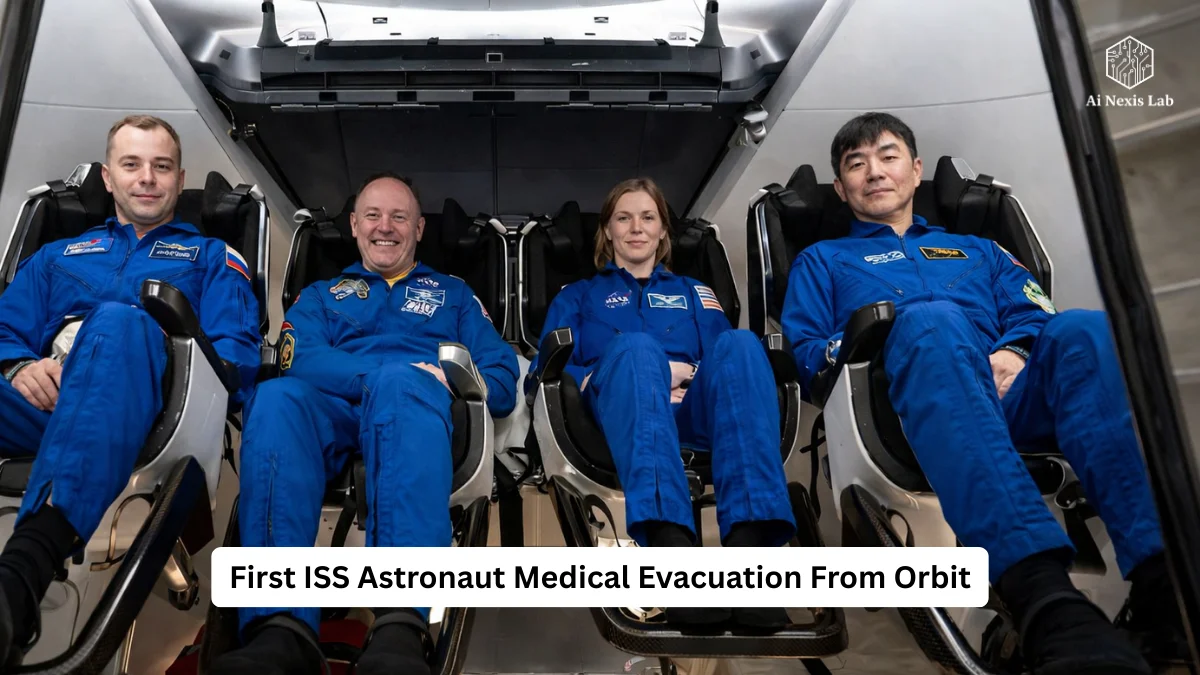
NASA’s first ISS medical evacuation brings 4 astronauts home early after an undisclosed illness aboard Space Station, marking a historic mission shift in Jan 2026.
On January 8-12, 2026, NASA made a historic breakthrough in the space program that everyone is talking about – and it wasn’t because of a new lunar rover or rocket test, but because of a medical situation aboard the International Space Station (ISS) that caused the planned mission to end early.
The problem? An astronaut aboard the ISS developed a medical problem so serious that NASA decided he could not be adequately diagnosed or treated in orbit – and the entire current crew was ordered to return to Earth early.
This is not marketing hype – this is the first time in 25+ years on the ISS that humans have been pulled down early due to illness.
Let’s look at what happened, why it matters, and what it reveals about the real limits of human spaceflight.
The Hard Facts: What Happened (Not What We Wanted)
1) This is not a scientific rescue or a dramatic SOS beacon – it is a calm but urgent medical evacuation.
NASA itself is not calling this a crisis in the dramatic sense. Officials say the affected astronaut is in stable condition – but they lack the medical capabilities to properly diagnose or treat the problem on the ISS.
That means:
- No dramatic alarms are sounding.
- No life-support systems have failed.
- There is no immediate threat to the station’s hardware.
It means that the person needs an evaluation or treatment that only someone on Earth can provide. NASA’s chief health officer and senior leadership said the station cannot handle any situation – even if it is not immediately life-threatening.
2) The primary crew involved is SpaceX Crew-11.
The current mission involved four astronauts aboard the SpaceX Crew Dragon Endeavour spacecraft – which launched on August 1, 2025 for a standard ~6-month mission.
Crew-11 includes:
- Zena Cardman (NASA)
- Michael “Mike” Fincke (NASA)
- Kimiya Yui (JAXA — Japan)
- Oleg Platonov (Roscosmos — Russia)
They were scheduled to stay until mid-February 2026. Instead, NASA ordered their mission to be ended early because one of them had a medical condition.
3) The spacewalk had already been canceled when the problem occurred.
On January 7, 2026, NASA canceled a planned spacewalk – the first ISS spacewalk of the year – due to crew member health concerns.
That cancellation was the first public sign of trouble.
4) NASA then announced the return of the crew.
Instead of waiting until February, NASA announced that Crew-11 will undock before noon EST on January 14, 2026, and splash down off the coast of California early on January 15.
That’s almost four weeks early – and that’s a big deal.

Why this matters – and why the word “unprecedented” isn’t clickbait
Let’s get something straight: someone getting sick in space isn’t entirely new. Astronauts have had minor health problems before – from kidney stones to minor infections – and they were often handled on the ISS itself with onboard medications and compatible equipment.
But this time, NASA concluded:
- The condition was beyond the station’s medical capabilities.
- It was safer to return to Earth sooner rather than later.
- It was better for the astronaut to treat it on Earth than to try to manage the potential risk of months in orbit.
That’s why this isn’t a regular medical log entry – it’s a landmark event.
The word “unprecedented” is appropriate in this context because:
- Never before has a long-duration ISS mission been cut short for obvious medical reasons.
- Previous early returns were due to spacecraft technical problems, crew rotation, or political/licensing reasons – not health.
- Spacewalks or experiments have been canceled due to medical complaints, but not entire missions.
- NASA, Roscosmos, ESA, JAXA, and CSA all coordinated this – meaning it is a global first.
You don’t need hype to see the significance here: this is a limiting case in human spaceflight operations.
Technically speaking: What does “medical evacuation” mean in this context?
In the public imagination, “evacuated from orbit” sounds like a scientific rescue craft arriving. No such thing is happening.
Here’s the reality:
1) There are always “lifeboat” docked to the ISS.
Currently, it is the SpaceX Crew Dragon Endeavour that has brought Crew-11 into orbit. Crew Dragon remains attached to the station while the crew remains there.
2) “Evacuation” simply means undocking and returning early.
The affected astronaut will ride the same Crew Dragon as his/her crewmates.
There is no dedicated rescue ship launched specifically for this – you don’t have to fly a special shuttle or call a space ambulance.
So, in strict terms:
- Medical evacuation = early undock and reentry
- Spacecraft already on station
- No additional launch required
- Splashdown and transfer to ground care
It’s still a big deal, but it’s logically limited by what’s already there.
Why NASA didn’t treat him on the ISS
The public assumes that advanced medical care is universal and portable. It’s not – especially in space.
ISS medical capabilities are limited by purpose
The ISS has:
- Basic diagnostics
- Portable ultrasound
- Limited pharmacy
- First aid and minor surgical capabilities (bandages, simple stitches, etc.)
But it cannot provide:
- Intensive care
- Complete radiology (CT/MRI)
- Surgery beyond the most basic
- Long-term monitoring beyond simple lifestyle
That’s not a flaw – it’s a design tradeoff. Every pound of medicine, equipment, and specialist tools sent into orbit is expensive and adds risk.
Space biology is not easy medicine
Some of the relevant factors that astronauts are already facing in microgravity:
- Fluid shifts toward the head
- Immune system dysregulation
- Bone demineralization and muscle loss
- Radiation exposure
- Limited wound healing response
These are not fictions – they are observed physical realities. And that makes certain conditions, especially acute or undiagnosed conditions, actively difficult to manage in orbit.
If an astronaut shows signs that could indicate anything from cardiovascular distress to a neurological cause, you need more advanced diagnostics than the ISS.
That’s why NASA is erring on the side of bringing the astronaut home – not out of panic, but out of rational risk management.
Impacts on the ISS and future spaceflight
A medical problem on the ISS is not just a human event – it affects the schedule and operations of the entire station.
1) Mission timeline shift
Crew-11 was supposed to stay until mid-February. Now:
- They are coming back on January 14-15.
- Crew-12 is still scheduled for mid-February, likely arriving before the ISS returns to full staffing.
- He could leave the station with a skeleton crew for several weeks.
This means that:
- Some experiments may be paused
- Spacewalks may be postponed
- Maintenance tasks may be postponed
NASA will have to strike a balance between scientific output and ensuring safety and continuity.
2) Psychological consequences for astronauts
It’s hard to see a companion leaving early when you’re hundreds of kilometers above Earth.
Astronauts train for exposure to hazards, technical failures, and high-stakes problems. But illness is a different class of vulnerability – unpredictable, personal, and emotionally taxing.
There are no official reports yet on the mood or performance of the ISS crew, but psychological research strongly suggests that sudden crew changes can affect cognitive workload and team dynamics.
This is important because human demonstration missions in space are important.
3) Operational Command Adjustment
In such cases, NASA had to ensure that the ISS had clear leadership when the returning crew departed and another arrived.
That change ensures:
- Task prioritization
- Safety oversight
- Clear communication channels
How command transfers in orbit occur is a procedural matter, but suffice it to say that continuity of command is critical to the health and safety of the station.
What does this say about Artemis and deep space missions
Here’s an honest view: This incident shouldn’t give anyone a false sense of security about future deep space missions.
The ISS is “close” – the Moon and Mars are not
The ISS is in orbit about 400 km above Earth – a relatively quick landing on Earth is possible.
- Moon or Mars missions are not the same:
- Return to lunar orbit takes days
Mars mission medical support could be weeks away
NASA and its partners have plans for medical autonomy in deep space, but they are years ahead of development.
This ISS incident is an awakening: medicine in deep space is a frontier problem – not a solved problem.
One reason why NASA prioritizes Artemis, Gateway, and autonomous medical research is that the reality in orbit exposes true human vulnerability.
Where is the current situation (as of January 12, 2026)
Here is the reality based on facts:
The ISS is stable and safe.
There is no hardware failure or structural crisis.
The medical issue is confidential – and that is standard practice.
NASA respects privacy and will not disclose health details without consent.
The astronaut’s condition is stable.
Officials specifically say that.
A short return to the mission is a precaution and a necessity, not a panic.
NASA says it’s about proper assessment and care on Earth.
Return is scheduled for January 14-15, depending on weather and recovery conditions.
Splashdown is expected near California.
The ISS will continue operations with personnel still aboard.
Three astronauts remain to maintain the station after Crew-11 departs.
The brutal truth about human spaceflight
Here’s the most hidden part of the modest coverage:
Humans are terrible in space.
We survive in space. We have designed systems to support us, but the human body – bones, muscles, immune system, cardiovascular system – is fundamentally fragile without Earth’s gravity.
Microgravity is not just “weightlessness”:
- Bone density decreases
- Muscles weaken
- Fluid changes
- Vision changes
- Immune function changes
It’s not theory – it’s proven science. And now we’re seeing how it works when you actually need real help in orbit.
Space agencies knew this, trained for this, designed contingencies – but this incident shows that even the best-planned missions still struggle with human biology first and technology second.
That’s not pessimism – it’s the hard truth of an expanded human space presence.
Frequently Asked Questions
Q: Was the ISS in danger?
A: No. The station itself is operationally healthy and stable. This was an issue of medical personnel, not a system failure.
Q: Did NASA send a special rescue ship?
A: No. An already docked Dragon capsule was used for the evacuation. There was no separate launch.
Q: Is this the first time an astronaut has returned early for medical reasons?
A: Yes – for ISS missions. Previous early returns occurred during the Salyut and Mir eras, but not in the ISS era.
Q: Do we know what illness is?
A: No. NASA has not released the details, citing medical confidentiality.
Q: Is the astronaut in immediate danger?
A: Officials say the astronaut’s condition is stable, which does not currently indicate a life-threatening emergency.
Q: Will this delay Artemis or the lunar missions?
A: There is currently no indication. NASA leadership says this ISS incident should not interfere with Artemis 2.
Q: What happens after splashdown?
A: The astronaut will be taken to a medical facility on Earth for evaluation and care.
Q: Will ISS research be paused?
A: Some experiments or spacewalks may be postponed until staffing levels return to normal.
Q: Who was left on the ISS after Crew-11 left?
A: A small team of three astronauts will maintain the station until the arrival of Crew-12.
Q: Does this change plan to retire the ISS?
A: No. Plans to retire the ISS around 2030-2031 are still in place.
The final reality check
This event is not the end of space exploration.
But it’s a clear sign that as we move forward – from low Earth orbit to the Moon and beyond – our understanding of human health in space is still immature.
The glass is neither half full nor half empty – it is the only glass we have.
NASA did not overreact. They responded to human needs within their functional limits.
And the world saw engineers and clinicians making real-time decisions with real humans at stake.
This is the serious, sugar-coated story behind the headlines.