The AI Agent Framework Wars of 2026
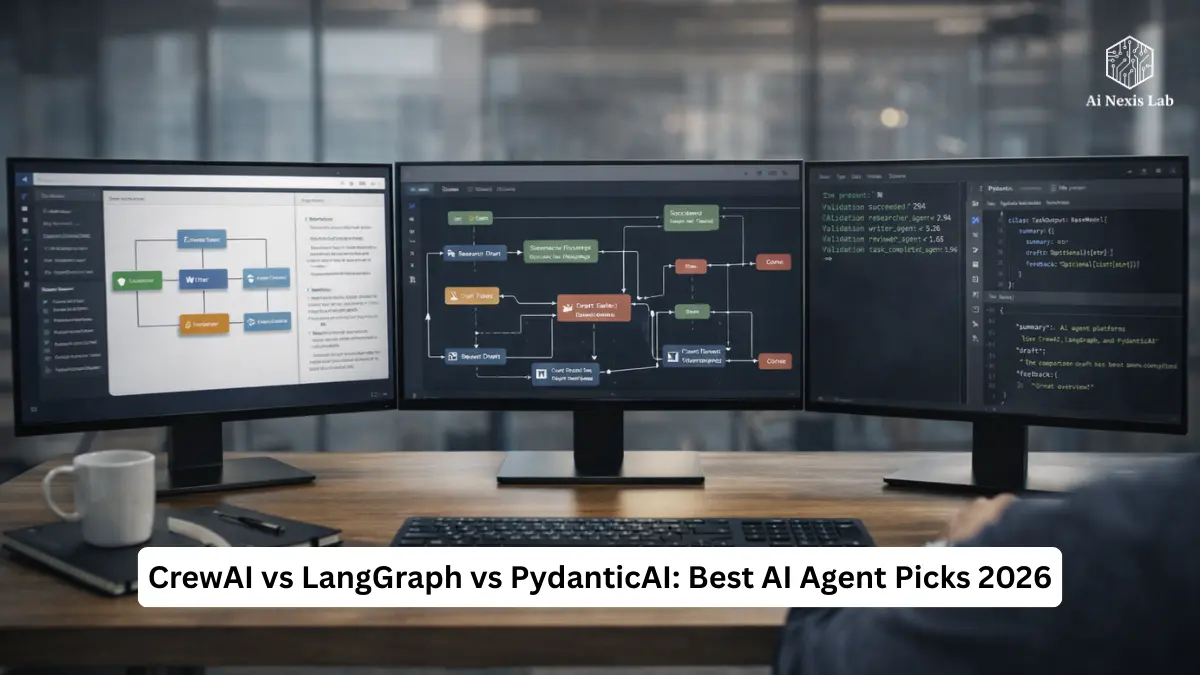
CrewAI vs LangGraph vs PydanticAI — Where we really stand, what you should watch out for and how to choose
Poiler, straight ahead: there is no single winner. But unlike most “framework wars” – which recycle the same debate points – 2026 is no longer about philosophical positioning. It’s about engineering trade-offs, product reliability, and the practical realities of deploying agentic AI systems at scale.
This is not hype. Here’s a practical look:
- What these frameworks actually do in 2026
- Where they shine and where they differ
- What real developer teams are using
- And how you make choices for real projects
I’ve consistently vetted trends through current documentation, ecosystem signals, and independent comparisons.
A Quick TL;DR for the Busy Builder
Before we get too deep, here’s the truth in simple terms:
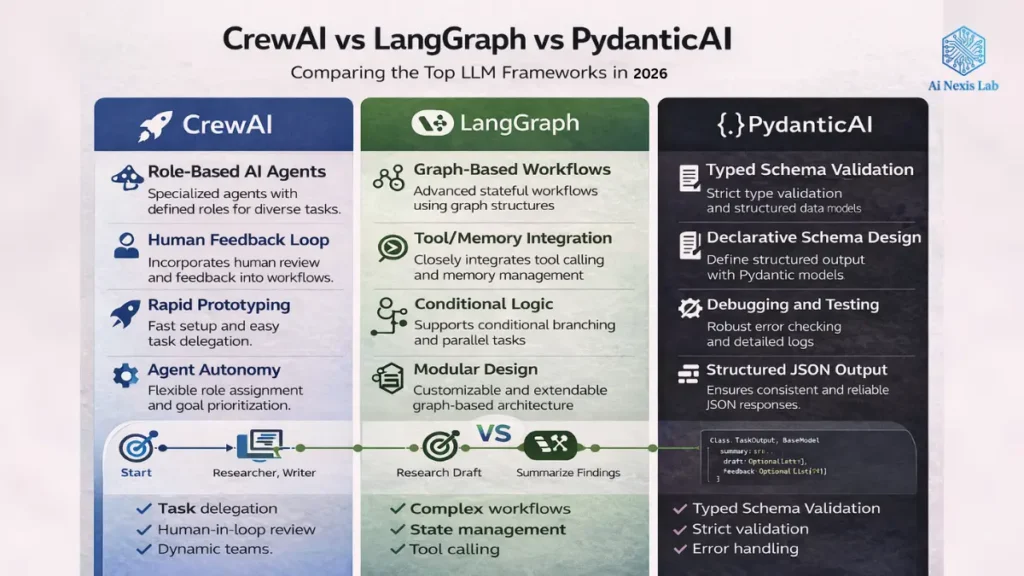
- CrewAI = The fastest way to organize multi-agent workflows with minimal code, best for creative content, team-like roles, and rapid prototyping.
- LangGraph = Engineer’s choice for precise, stateful, deterministic workflows with powerful debugging and rollback, ideal for mission-critical systems.
- PyDenticAI = A type-safe, production-grade foundation for agents that should be reliable, maintainable, and integrated into large Python applications.
Each has its place – and they are complements to each other, not complete replacements for each other. That’s the real 2026 landscape.
Why this matters in 2026
A lot has changed since the early days of “chat with your PDF”.
In 2023-2024, we were building reactive assistants. In 2025, developers began automating tasks. Now, in 2026, the focus has shifted decisively to governability, observability, structured logic, and reliability. Agents are no longer toys; they are critical infrastructure.
The predicted consequences of this change are:
- Teams need observability – understanding exactly what happened and why.
- Agents need repeatability – so the output is not a black-box gamble.
- Workflows are multi-step, stateful, and cyclical – simple chains just don’t cut it.
And that’s where this framework falls apart.
1) CrewAI: “The Human-Metaphor Orchestrator”
What it really is
CrewAI is a Python-centric, multi-agent orchestration framework where agents are defined in terms of roles – such as “researcher,” “analyst,” or “editor.” You manage them almost like employees in a workflow: assign tasks, delegate work, and get results back.
This metaphor is powerful because it reflects human thinking. Want to gather, analyze, and write a team of three agents? CrewAI makes it easy.
CrewAI’s own documentation emphasizes its role-based design and real-world workflow orchestration.
What makes CrewAI the best
Development speed and clarity of roles
If you need to go from a bare IDE to a working multi-agent pipeline in less than 100 lines of code, CrewAI wins. Its syntax and abstractions are designed not for rigid engineering constraints, but for exploratory workflows.
Human-in-the-loop checkpoints
CrewAI supports simple manual review checkpoints – a human reviewer can approve or edit before the next stage. It is also huge for editorial workflows, content production, or regulatory workflows where a human must sign off.
Role abstraction = intuitive
Assigning agent tasks feels more like defining a team mission than wiring a state machine.
Where CrewAI Loses Real-World Points
1) Black-Box Drift:
Because much of CrewAI’s control flow is internally driven by natural language directives, agents can “drift” over long, complex loops. CrewAI does not enforce strict schemas or deterministic transitions like a graph or type system.
2) Limited engineering tooling:
CrewAI is strong for prototyping and content production, not so strong for enterprise workflows that require deep traceability and determinism.
3) Observability Challenges:
CrewAI has nothing like Langsmith’s visual trace. It is important when you need to debug a multi-agent running in production.
Typical Use Cases
- Marketing Content Pipelines
- Research + Summarization
- Data Enrichment Workflows
- Team-Style Agent Collaboration
CrewAI is a rapid build when conceptual clarity and velocity overcome strict logic limitations.
Bottom line: CrewAI lets you think in teams, not engines. That’s its strength — and its weakness.
2) LangGraph: “State Machines Done Right”
What LangGraph Really Is
LangGraph is an evolution of the LangChain ecosystem — a graph-first agent framework where each step of a workflow is a node and each transition is an edge.
This isn’t just fancy mapping — it makes agent flows determinable, debuggable, repeatable, and observable.
Langgraph’s model is built for engineers who think in terms of state machines. Your system behaves like a program, not like a natural language corrector.
Langgraph also connects deeply with Langsmith for observability — meaning you can actually see every node, every transition, every variable. That’s invaluable in real systems.
What makes Langgraph win
1) Precision and determinism
If an agent fails a step, you can loop back, handle retries, log the reason, and continue — without having to guess what happened next. This makes Langgraph great for mission-critical workflows.
2) Graph-driven debugging
You don’t just log lines; you visualize them. Teams can inspect “what happened here” at any node. That’s Sophisticated Engineering 101.
3) Conditional and Cyclic Workflows
Linear chains just won’t cut it for real systems. Langgraph handles branching, retries, error handling, and dynamic routing like a pro.
Where Langgraph loses out in practice
1) Learning curve
Langgraph is not “point and click”. You need to reason in terms of graph states, transitions, and contracts – that requires discipline.
2) Create time overhead
You spend more time architecting the workflow in advance, which can slow down early prototyping.
3) Impedance mismatch for content workflows
If you just want a newsletter generator that uses the “writer + editor + reviewer” pipeline, the graph overhead seems heavy.
Typical Use Cases
- Enterprise automation (e.g., customer support pipelines)
- Automated code review + test runs
- Safety-critical agent tasks
- Long-running workflows with retries, rollbacks, and state checkpoints
Langgraph isn’t fancy – it’s industrial.
It turns chaotic agent runs into software engineering artifacts that you can version, test, and maintain.
3) PydanticAI: “Production-grade type safety”
What PydanticAI really is
PydanticAI brings the FastAPI design philosophy to the agent framework. It is built by the same creators as Pydantic – the foundational Python type validation library – and prioritizes type safety, structured output, dependency injection, and runtime cleanness.
In 2026, type safety is not an academic exercise – it is a necessity. When an agent makes a call to your backend, messing up the schema can mean database corruption, failed API responses, or even worse.
PydanticAI makes data purity a first-class citizen.
Why is this important
Catches errors early – Type checkers (mypy, pyright) catch errors before runtime.
Reliable structured output – You get predictable, schema-validated data.
Dependency injection for workflows.
Performance-friendly architecture — and alternative streaming with validation.
Where PydanticAI shines
1) Strict schema validation
This is not “ask for JSON – hope for the best”. PydanticAI enforces schema to ensure tools and output match your expectations.
2) IDE and Tooling Support
Your IDE understands exactly what the agent will produce, improving developer velocity and confidence.
3) Maintainability
As teams grow and systems become complex, being able to reason about each data structure is a huge advantage.
Where PydanticAI is not enough on its own
PydanticAI is not a complete multi-agent orchestrator today. You can build one – it even has a graph extension – but it’s basically a type-safe agent engine, not a workflow orchestrator like LangGraph or CrewAI.
It is ideal when you need to embed agents as components in larger software – for example:
- AI-powered FastAPI backend
- Valid event processor
- Structured decision engine in microservices
In these situations, you need PydanticAI. In other situations, you can choose LangGraph or CrewAI and choose Layer Validation on top.
Side-by-side comparison
| Attribute | CrewAI | LangGraph | PydanticAI |
|---|---|---|---|
| Philosophy | Human-like team roles | State machine graph | Type-safe object model |
| Ease of Starting | Very easy | Medium | Medium |
| Determinism | Moderate | Very High | Very High (schema correctness) |
| Multi-agent orchestration | Yes | Yes | Yes (via extensions) |
| Observability | Basic | Advanced | Basic → extensible |
| Type safety & schema validation | Low | Medium | High |
| Best for | Creative workflows | Mission-critical systems | Backend components & APIs |
This isn’t marketing fluff – this is how team engineers actually choose frameworks today.
What the real world is really building in 2026
Three trends are clear:
1) Observability wins. Real deployments are not shipped without tracking, logs, and traceability. There is a real differentiator here, paired with Langgraf Langsmith.
2) Type safety is not optional. Once agents started executing business logic and database rights, the cost of schema errors quickly became visible – and frameworks that build validation into the core were gaining ground.
3) Hybrid stacks are becoming commonplace. Teams are mixing frameworks:
- Langgraph for core workflow logic
- PydenticAI for data accuracy
- CrewAI for content-centric subflows
Framework interoperability is the new frontier – not framework supremacy.
Frequently Asked Questions
Q: Which structure should I learn first?
A: If you are a backend engineer: Start with PydanticAI for type safety and software discipline.
If you’re an AI builder focused on workflow automation: start with LangGraph.
If you’re concerned about rapid prototyping and content workflows: Get started with CrewAI.
There’s no single “wrong” choice. It depends on your context.
Q: Is Langgraph replacing Langchain?
A: No. Langgraph is derived from the Langchain ecosystem but represents a different paradigm focused on state graphs and flows – not a replacement, but an evolution for complex workflows.
Langchain still exists as a foundational chain structure.
Q: Can I use PydenticAI with Langgraph?
A: Yes — and that’s what developers do all the time. PydanticAI provides strong validation and type safety, while LangGraph manages nodes and transitions. They complement each other rather than compete.
That’s the new reality.
Q: How mature is CrewAI in production use?
A: CrewAI is widely used for prototypes and mid-level workflows, and numerous companies are now using it in manufacturing content automation. But its internal control flow is not as robust or debuggable as Langgraph, so it is often combined with monitoring and external checkpoints for mission-critical workflows.
Q: Which is the most enterprise-ready?
A: Langgraph wins here — due to determinism, observability, and strong engineering tooling. For enterprise use, predictability beats friendliness.
CrewAI and PydanticAI are perfectly viable — but they require more architectural guardrails from the surrounding system.
Q: What about other frameworks (Autogen, Microsoft Agent SDK, etc.)?
A: There are many players – Microsoft’s AutoGen, OpenAI’s Agents SDK – but the three we’re comparing form the core, language-agnostic, and Python-centric backbone of agent development in 2026.
Other tools are complementary or more specialized.
Q: Will this shift by 2027?
Yes — but the key engineering tradeoffs will probably remain:
1) Human-centric abstraction
2) Stateful graph control
3) Type-safe production systems
These three represent fundamentally different architectural philosophies.
Q: Is this just hype?
A: No. The frameworks we are talking about here are chosen based on developer experience, product reliability, and long-term maintainability, not just marketing talk. Every choice involves real tradeoffs — I’ve tried to be clear about them above.
Final Verdict
There is no such thing as a “framework that wins everything”.
There are frameworks that overcome specific problems:
- CrewAI for creative, collaborative agent workflows.
- Langgraph for robust, engineering-grade workflows.
- PydenticAI for type safety and backend reliability.
In the messy reality of 2026, the best teams aren’t monogamous – they choose the right tool for the right job.
It’s not fragmentation – it’s a specialized engineering discipline.