
Rocket Lab: From underdog launcher to space powerhouse – and why its story may only be beginning

A quiet revolution is taking place in the new space economy – and most people still don’t understand it.
Over the past decade, we’ve seen dozens of aerospace startups promising reusable rockets, cheap launches, lunar landers, space tugs, orbital factories, satellite internet… the list is long. Many burned cash. Many disappeared. Some were acquired. A few survived.
And then there’s Rocket Lab.
What started as a small company launching small rockets from New Zealand has slowly, methodically become one of the most strategically important players in the Western space ecosystem.
Investors finally took notice.
Share prices soared. Early believers took profits. Critics called it “overextended.” Some analysts suggested that it could go too far, too fast.
But here’s the thing:
The business story unfolding beneath the stock price is much bigger than most people realize. Rocket Lab is no longer operating like a speculative startup. It’s starting to look and act like a cornerstone of national security.
And that’s not an exaggeration. It’s structural.
In fact, there are three main pillars driving this transformation, and together they suggest that Rocket Lab is not simply riding a hype cycle. It is creating a sustainable, long-term position in the middle of a space economy where the competition is surprisingly thin – and the stakes are huge.
Let’s break down those pillars.
$3.5 Billion Turning Point: Rocket Lab Enters Defense Prime Club
For decades, a handful of American aerospace giants dominated government space contracts. Think of names like:
- Lockheed Martin
- Northrop Grumman
- L3Harris
- Boeing
They were the “default” choices. If you were the Pentagon and needed something advanced, expensive, and classified – you would have called one of them.
Then, in late 2025, something remarkable happened.
The U.S. Space Development Agency awarded contracts to build 72 missile-tracking satellites — a program central to U.S. national defense and monitoring global threats.
And Rocket Lab simply wasn’t included.
It was selected as the prime contractor – responsible for building and delivering 18 satellites in a deal worth approximately $816 million, part of a broader $3.5 billion program.
That title – prime contractor – is important.
It means:
“We don’t just trust you as a supplier. We trust you to execute the mission.”
That’s a completely different level of responsibility and reliability.
Why did Rocket Lab win?
There are a few different reasons.
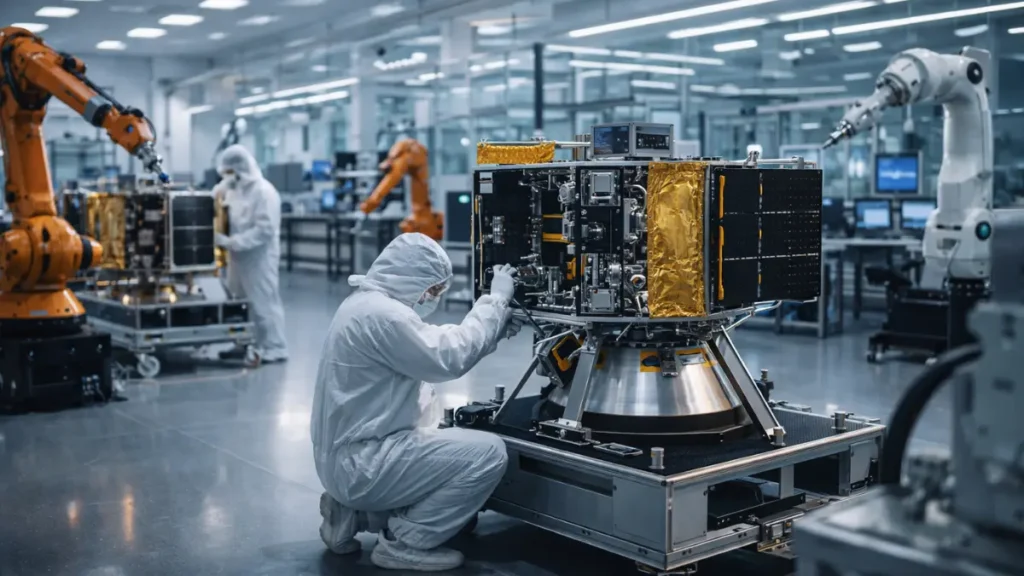
True Vertical Integration
Most aerospace companies assemble satellites the way automakers assemble cars – buying parts from dozens of suppliers, coordinating timelines, adding up costs, and praying that everything goes right.
Rocket Lab took a different path.
It makes:
- Solar arrays
- Reaction wheels
- Flight software
- Satellite buses
- Avionics
- Components acquired through strategic purchases like Geospatial
That means fewer vendors, fewer delays, tighter quality control, and faster delivery.
For the Pentagon – especially with rising geopolitical tensions – speed and reliability beat brand heritage every time.
The “Trench” Momentum Effect
The deal falls into SDA’s proliferated warfighter space architecture, which begins in a phase called “Trench.”
Deliver once – on time, on budget – and suddenly you’re on the shortlist forever.
Each trench strengthens the other. A combination of trust.
The backlog becomes a fortress
That one contract nearly doubled Rocket Lab’s backlog.
This is more than accounting noise. A thick backlog gives Wall Street something incredibly valuable:
Predicted, contracted revenue that isn’t based on hype, launches, or speculation.
In other words:
Rocket Lab is no longer “a cool rocket company.”
It looks eerily similar to a defense utility – with recurring cash flows tied to national security priorities.
And they don’t disappear in a recession.
The electron has its own lane – and the neutron can change everything
Projection has always been a fascinating aspect of space.
The rocket roars, the booster lands, the engine glows – and the headlines explode.
SpaceX understandably gets the attention, and rightly so. The Falcon 9 is a marvel. There’s no arguing that.
But while the world watched giant rockets, Rocket Lab quietly built one of the most valuable infrastructures in the industry.
Electron: Small but Deadly Compatible
Electron specializes in small, dedicated payloads – missions where:
- Time is of the essence
- Precise orbital location is critical
- Sharing a ride with 40 other satellites isn’t ideal
What if a company, government lab, or military branch needs to put something where they want it, and when they want it?
They don’t wait months to get a ride.
They call it Rocket Lab.
In 2025, Electron completed a milestone year, flying 21 missions with perfect mission performance.
Reliability turns into loyalty. And loyalty turns into contract renewal.
Neutron: The Next Chapter
If the electron is a precision scalpel, the neutron is designed to be a workhorse.
The neutron rocket moves the lab into the medium-lift region – the region where constellations are launched and refueled. It is reusable, innovative in structure, and directly targets the area where growth is exploding.
Yes – it’s set to launch in early 2026.
But rocket delays are not signs of weakness. Those are usually signs of discipline.
“Measure twice, cut once” is how companies survive in this business for the long term.
Meanwhile:
- “Hungry Hippo” Fairing Completes Qualification Testing
- Archimedes Engine Continues Hot-Fire Progress
- Production Infrastructure in Place
And Here’s the Kicker:
The Neutron is designed with military and constellation launches in mind – exactly the kind of missions that governments don’t want to be completely dominated by a single provider.
NSSL Lane 1: The Real Prize
The National Security Space Launch Program has allocated billions of dollars for vehicles capable of flexible missions without Falcon-9-scale lift capacity.
The Neutron fits that window almost perfectly.
When it successfully flies – not if, but when – Rocket Lab’s potential market doesn’t grow by 20-30%.
It multiplies.
Many investors haven’t priced it out yet because Wall Street is notoriously bad at evaluating “unproven but highly probable” phases.
But the organizers of the conservation program? They think in decades.
And they can already see where the neutrons are.
Rocket Lab is no longer just a rocket company – it’s becoming a space systems group
This is the most misunderstood part of the story.
If you still think of Rocket Lab as an “electronics company,” you’re missing a big strategic arc.
More than half of the company’s revenue now comes from space systems – which means:
- Building spacecraft components
- Assembling entire satellite platforms
- Selling technology that other companies rely on
In the third quarter of 2025, the company posted record revenue of approximately $155 million, driven largely by these systems and hardware businesses.
Margins improved. Costs stabilized. Scale began to matter.
And then came acquisitions like Geost, which brought cutting-edge optical and infrared sensor capabilities into the fold.
He changed Rocket Lab from:
“We can build what you want to carry”
to:
“We can build what we can see.”
Sensors are where the real strategic value lies. Data, surveillance, missile detection, climate monitoring, commercial imaging – the list of customers is endless.
A financial position with breathing room
Unlike many peers, Rocket Lab is not constantly raising diluted emergency capital.
With more than $1 billion in liquidity, it can:
- Complete neutron development
- Scale manufacturing
- Selectively acquire strategic technologies
- Resist market turbulence
Cash buys time – and in aerospace, time almost always translates into capacity.
This is how you peacefully evolve into a group.

Competitive Edge: Why Rocket Lab’s Strategy Is Hard to Copy
The most misunderstood part of Rocket Lab’s rise is how deliberately the company has built its advantage. From the outside, it’s easy to say “SpaceX can do this too.” But when you zoom in, Rocket Lab is playing in a different realm — and that’s intentional.
Where many space startups pursue the biggest rockets and most ambitious missions, Rocket Lab focused on something more practical: repeatability, reliability, and integration. They didn’t try to win by being the loudest – they chose to call on vendor governments and commercial players when they couldn’t afford delays.
That mentality is visible everywhere.
The Electron wasn’t designed to just be “nice and small.” It was designed to give customers their own dedicated ride in their chosen orbit, on their chosen schedule. That means weather risks are reduced, unfolding conflicts disappear, and security-sensitive payloads aren’t traveling with unknown neighbors. In defense and intelligence work, it is invaluable.
The same logic applies to space systems. Instead of waiting for a launch contract, Rocket Lab built a portfolio that generates revenue even when the rockets aren’t flying. Reaction wheels, satellite buses, sensors, avionics – these are the invisible parts of space missions that keep paying off year after year.
And then there are neutrons.
The Neutron is not trying to be a Falcon 9 clone. It is specifically designed for constellation deployment, rapid reusability and increasing mid-lift specificity where customers want something more economical than a heavy rocket but more capable than a small launcher. That is the lane where future demand lies.
Add defense reliability – already proven by satellite programs – and you begin to see how each part reinforces the others. The more systems Rocket Lab builds in-house, the cheaper and faster it becomes to deliver end-to-end missions. This is how monopolies are quietly formed: not because competitors can’t build rockets, but because they don’t fit into a fully integrated ecosystem.
None of this means that Rocket Lab is risk-free. Neutrons still need to fly, implementation must remain disciplined, and competition will intensify. But the path Rocket Lab is on seems less speculative propaganda and more patient infrastructure construction.
And infrastructure—once built—is designed to last for decades.
As the risk of global conflict increases and governments accelerate investment in satellite defense networks, companies that can provide fast, affordable, and scalable space capabilities will become strategic necessities.
Rocket Lab is no longer selling rides into space.
It is selling access, resilience and security – and it could prove to be the most valuable business model in the industry.
The Psychology of Selling Too Early
Recently, an investor wrote publicly that he sold half of his Rocket Lab position after a big gain. There’s nothing irrational about that. It’s wise to protect profits.
But the comparison they inadvertently invited was interesting.
Selling Rocket Lab now feels like selling Amazon back to when it was “just an online bookstore.”
Because what is emerging here is not just a launch service provider or a parts manufacturer.
Rocket Lab is helping to build:
- Resilient military architecture
- Commercial satellite infrastructure
- National security capabilities
- Future-proof launch flexibility
In short:
It is one of the companies wiring the orbital economy itself.
When history looks back, the main question might not be:
“Was Rocket Lab once a little overvalued?”
It would be:
“How could we not see the role she was developing into?”
The company isn’t just trying to reach the moon.
It is building roads, toll booths, and fuel stations for everyone trying to get there.
Frequently Asked Questions: Rocket Lab, Growth Potential, and Investor Concerns
Q1: Is Rocket Lab dangerous because it is still developing neutrons?
Any rocket development carries risks. But Rocket Lab isn’t betting the entire company on neutrons. It has various revenue streams, government contracts, and a proven launcher that is already operational. It significantly reduces the risk of loss compared to pure-play “one-rocket” startups.
Q2: Could government contracts disappear?
Unlikely – especially in the current geopolitical climate. Missile tracking, communications resilience, and satellite redundancy are now national priorities. If anything, costs are rising. Contracts may change, but demand is not decreasing.
Q3: How does Rocket Lab really compete with SpaceX?
It’s not trying to outdo SpaceX, despite being SpaceX. Instead, it:
1) Dominates small dedicated missions
2) Replaces Neutron for mid-level launches
3) Integrates deeply into satellite production
It is competing for different parts of the pie rather than going head-to-head with each other across the board.
Q4: Will Neutron really become cost-competitive?
This is the purpose – reusable design, optimized manufacturing, and vertically integrated parts aimed at reducing cost per launch. We’ll know more once its flight campaign begins, but the design philosophy clearly prioritizes economics, not just grandeur.
Q5: Is Rocket Lab still profitable?
Profitability in aerospace often comes in waves. What matters is that its activity is growing – and margins are moving upwards thanks to high-value contracts and scalable satellite systems. The company is moving towards sustained profitability rather than chasing growth at any cost.
Q6: Could new competitors disrupt Rocket Lab?
Possibly, but the barriers to entry are very high: engineering talent, supply chain, government trust, infrastructure, and proven flight history. Rocket Lab has already overcome obstacles that overcome most challenges.
Q7: What is the biggest risk?
Execution. Rocket Lab must deliver satellites on time, prove neutrons, and maintain reliability. A major failure will slow the pace – but their engineering discipline so far suggests they understand this better than most.
Final thoughts
Some companies in space are building attractive rockets. Some are pitching futuristic ideas. Some are burning through investors’ money in spectacular fashion.
Rocket Lab is doing something even more boring – and more powerful.
It is quietly embedding itself into the infrastructure layer of modern space operations, where:
- Governments depend on you
- Customers return again and again
- Capabilities grow over time
If you zoom out, the picture becomes clearer:
Rocket Lab doesn’t chase headlines. It’s building a foundation.
And the foundation transcends the hype cycle.